
Understanding what price action is among the first steps towards becoming a better trader. Instead of relying on multiple indicators, price action trading focuses on analysing a stock's price movement to identify potential trading opportunities. Since price reflects the balance between buyers and sellers, many traders use it to understand market sentiment and make informed decisions.
Whether you're new to trading or looking to improve your analysis, learning about price action in the stock market can help you build a disciplined trading approach.
What Is Price Action?
Price action refers to the movement of a stock's price over a specific period. In simple terms, it involves studying price charts, candlestick patterns, and support and resistance levels instead of depending only on technical indicators.
For example, if a stock repeatedly bounces from ₹500, traders may identify it as a support level and look for buying opportunities. Understanding price action meaning helps traders read market behaviour and make decisions based on actual price movements.
How Price Action Works
To understand how price action works, it's important to know that prices move because of buying and selling activity. When buyers outnumber sellers, prices generally rise, while increased selling pressure pushes prices lower.
Price action traders analyse chart patterns, trends, and candlestick formations to identify possible entry and exit points. This helps them react to market movements rather than relying solely on lagging indicators.
Benefits of Price Action Trading
Some key benefits of price action trading include:
- Easy to learn and understand.
- Suitable for intraday, swing, and positional trading.
- Can be used across stocks, Commodities, Forex and Indices.
- Helps traders understand market psychology.
- Works well with support and resistance analysis.
Key Price Action Trading Patterns
Some commonly used price action trading patterns are:
- Pin Bar: Indicates possible price rejection.
- Engulfing Pattern: Signals a potential trend reversal.
- Inside Bar: Shows consolidation before a breakout.
- Double Top & Double Bottom: Popular reversal patterns.
- Breakout Pattern: Occurs when price moves above resistance or below support.
How to Build Price Action Trading Strategies
A good price action strategy starts with identifying the market trend. Next, mark important support and resistance levels and wait for confirmation through candlestick patterns before entering a trade.
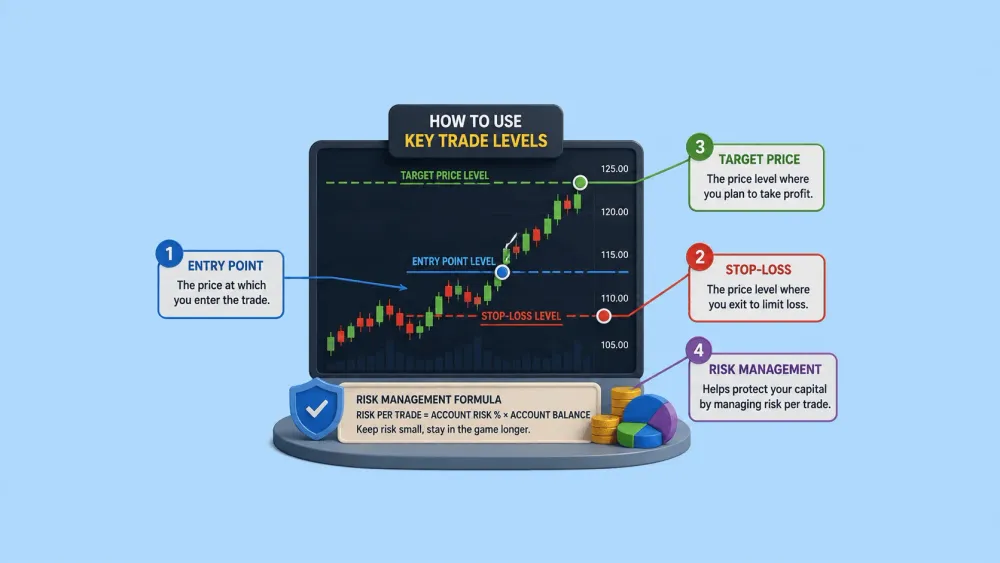
Every strategy should include:
- Entry point
- Stop-loss
- Target price
- Risk management
Following these rules can help traders maintain discipline.
Different Tools Used for Price Action Trading
Although price action mainly focuses on price movement, traders often use supporting tools such as:
- Candlestick charts
- Trendlines
- Support and resistance levels
- Volume analysis
- Moving averages
- Fibonacci retracement
Some traders also use a price action indicator, but price itself remains the primary source of analysis.
Price Action Trading Strategies for Beginners
If you're planning to learn price action trading, it's important to keep your approach simple. Instead of trying multiple strategies at once, focus on understanding how prices behave around key levels and follow a structured trading plan. As you gain experience, you can refine your strategy based on your trading style and risk tolerance.
Some beginner-friendly price action trading strategies include:
- Trade in the direction of the trend.
- Buy near support and sell near resistance.
- Wait for breakout confirmation before entering.
- Use simple candlestick patterns for trade confirmation.
- Always place a stop-loss to manage risk.
No strategy guarantees profits, and beginners should avoid taking trades based solely on a single signal. Regular practice, analysing past charts, and maintaining discipline can help you learn price action more effectively and build confidence over time.
Common Mistakes to Avoid
Many beginners make mistakes while learning price action. Some common ones include:
- Trading without a plan.
- Ignoring stop-loss orders.
- Taking trades against the trend.
- Overtrading after losses.
- Depending only on one pattern without confirmation.
Avoiding these mistakes can improve consistency over time.
Conclusion
Learning what price action is helps traders understand how the market behaves without relying on multiple indicators. While price action trading work depends on the trader's discipline, risk management, and experience, it remains one of the most widely used trading methods. By practising regularly and following a structured price action strategy, traders can gradually build confidence and improve their decision-making.
FAQs
Does price action trading work?
Yes, price action trading can be effective when combined with proper risk management, discipline, and consistent practice. However, no strategy guarantees profits.
How to find price action in stocks?
To understand how to find price action in stocks, study price charts, identify trends, support and resistance levels, and observe candlestick patterns that indicate potential buying or selling opportunities.
What Is the Best Timeframe for Price Action Trading?
There is no single best timeframe. Intraday traders often use 5-minute or 15-minute charts, while swing traders prefer daily charts and long-term investors may use weekly charts.
Is price action trading good for beginners?
Yes. Since it focuses on price movements instead of multiple indicators, learning price action is often considered a good starting point for beginners. However, practising on paper trades before investing real money is recommended.
Disclaimer: This article is for educational purposes only and should not be considered investment or trading advice. Investments in the securities market are subject to market risks. Please do your own research or consult a financial advisor before investing.
Related Blog


Nifty Prediction For Tomorrow The Nifty 50 tomorrow market prediction indicates a Sideways trend. The range is between 22500 and 22800, with support at 22500-22550 and resistance at 22750-22800. Traders should monitor these crucial levels closely for potential market shifts. Nifty 50 Share Price * Nifty Support: 22500-22550 * Nifty Resistance: 22750-22800 * BIAS: Sideways to Bullish 20-Day EMA 50-Day EMA 100-Day EMA 200-Day EMA 23072.31 23518.70 23803.70 24111.80 Nifty Range
6 October 2026

Copper Price Forecast for Next Week (05 October- 9th October 2026) Support 2 Support 1 CMP Resistance 1 Resistance 2 1360 1380.55 1398.95 1412.70 1440 LME Copper prices declined around 3% WoW, closing the week on a negative note as signs of softer industrial activity in top consumer China weighed on the demand outlook. The metal also faced pressure from a stronger US dollar, elevated bond yields and rising oil prices, which heightened inflation concerns amid geopolitical tensions. On
3 October 2026

Natural Gas Price Prediction for Next Week (5th October - 09th October 2026) Support 2 Support 1 CMP Resistance 1 Resistance 2 268.50 280 288.10 300.40 314 US Natural gas prices declined around 5% WoW, pressured by expectations of stronger production and relatively mild weather limiting heating and cooling demand. The EIA reported a 64 Bcf storage build for the week ended September 25, in line with forecasts but below the five-year average of 80 Bcf. Lower-48 production averaged a re
29 September 2026
Made for Traders.
Trusted by Investors.
Download FinX — trade confidently, invest
smarter, track everything.