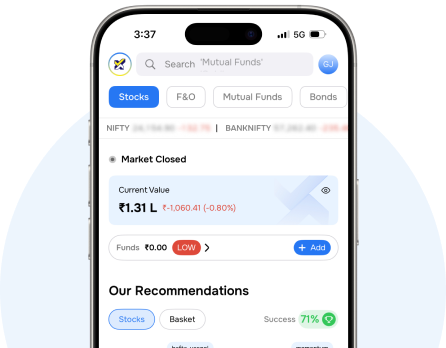

Keeping an eye on the stock market throughout trading hours isn't always possible. But that doesn't mean you have to sit out until the next trading day to act on your investment decisions. This is where the After- Market Order (AMO) comes in, allowing you to place your trades even when the market is closed.
In this blog, we'll break down what after-market orders are, how they work, their key characteristics, benefits and limitations, and the different types available to investors.
What is An After-Market Order?
An after-market order is a facility that lets you place buy or sell orders for stocks, derivatives or currency contracts outside the regular trading window of 9:15 AM to 3:30 PM. Instead of placing your orders during market hours, you place orders during the evening, at night, or early in the morning, where your broker holds them until the exchange reopens.
How Does After-Market Order Work?
The process for placing an AMO happens in three stages:
Placement: You log in to your broker’s app or platform and place a sell or buy order after-market hours (in the evening, at night, or early in the morning) just as you would do during the day. You choose the stock, quantity and order type.
Queueing: Your broker safely holds this order in their system. The order isn’t sent to the exchange yet as it is closed.
Execution: At the start of the next trading day, your broker sends the order to the exchange once the order collection window opens. From there, depending on the segment and order type, it may either take part in the pre-open session (for equities) or simply go live once regular trading begins.
If the price conditions are met, the order may get executed. If not, the order may get cancelled or carried forward, depending on the order type and exchange rule.
Key Characteristics of AMOs
- Placed after hours, executed later: You place the order when markets are shut, but execution only happens once trading resumes.
- Available across segments: AMOs typically work for equity, futures and options (F&O), and currency derivatives, with commodity markets often following a different schedule since they run longer hours.
- Can be modified before execution: Most brokers let you edit or cancel your AMO any time before it's sent to the exchange the next morning.
- Subject to price risk: Since the order executes only when the market opens, the price you eventually get may differ from what you expected, especially if there's overnight news.
- Broker-dependent cut-offs: Exact timings for placing and processing AMOs can vary slightly from one broker to another.
Benefits of Using AMO
- Convenient for busy investors: If you can’t watch the market live, AMOs let you make your trading decisions on your own time, whether that’s late night or early morning.
- React to overnight developments: Global markets, company announcements, or news events sometimes happen after Indian market hours. AMOs let you position yourself based on this information before the market opens, rather than trading during the rush market hours.
- Reduces impulsive, in-the-moment decisions: Placing an order calmly the evening before, after research, can sometimes be a more disciplined approach than reacting in the heat of a fast-moving session.
- No need to constantly monitor your screen: Once your AMO is placed, you don’t need to constantly monitor your trading app until 9:15 AM.
Limitations and Risks
AMOs are useful, but they come with a few limitations and risks that you need to keep in mind:
- Price uncertainty: If you place a market AMO (without specifying a price), your order executes at whatever price is available when the market opens. This price could be quite different from the previous day's closing price, particularly if any major news or events occur overnight.
- Partial fills or non-execution: Depending on liquidity and price movement, your AMO may only get partially executed, or in some cases, may not execute at all if the price moves outside your specified range.
- Not ideal for highly volatile stocks: For stocks that tend to be volatile, an AMO placed without considering market conditions or doing proper research may lead to unexpected results.
- Modification window is limited: While you can usually change or cancel an AMO before the market opens, once it's pushed to the exchange, you lose that flexibility.
- Cannot be used for every product: Some contracts or trading segments may not support AMOs, so it's important to check with your broker.
After market order time
AMO timings vary slightly by exchange and segment, and individual brokers may apply their own cut-offs within these broader windows. These are the after market order timings of different segments:
| Segment | Timing |
|---|---|
| NSE Equity | 3:45 PM to 8:57 AM the next trading day |
| BSE Equity | 3:45 PM to 8:59 AM the next trading day |
| Futures & Options (F&O) | 3:45 PM to 9:10 AM the next trading day |
| Currency Derivatives | 3:45 PM to 8:59 AM the next trading day |
The commodity AMO timing varies by broker and market timings.
Note: Most brokers pause AMO placement during the post-market session or during system maintenance windows. It's good to check your specific broker's timing before you plan your trade.
Types of AMO
1. Market AMO: In this type of AMO, you don't specify a price. The order executes at whatever price is available when the market opens. This offers speed but no price control, so it is better to use it with caution, especially for volatile stocks.
2. Limit AMO: You specify the exact price at which you're willing to buy or sell. Your order only executes if the market price matches or is better than your limit. This gives you more control, though there's a chance the order may not get executed if the market price does not meet your limit.
Note: A Limit AMO that doesn't get executed during its validity period may simply expire, depending on the validity period you've chosen. It's a good idea to review your order status regularly to see whether it has been executed, is still pending, or has expired.
AMO vs Other Order Types
| Feature | Regular Order | AMO |
|---|---|---|
| Placement time | During market hours (9:15 AM–3:30 PM) | Outside market hours |
| Execution | Immediate, if price matches | Only at the next market open |
| Price visibility | Live market price visible | Price is only known at execution |
| Best suited for | Active traders monitoring the market | Investors who can't trade live |
| Flexibility to modify | High, throughout the session | Limited to before execution |
Who Should Use AMO?
AMOs tend to work well for:
- Working professionals who can't monitor the markets during regular trading hours.
- Long-term investors who want to place orders for stocks they've already researched, where short-term price fluctuations matter less.
- Investors reacting to global news, such as overnight movements in US markets or major corporate announcements, want to position themselves before the opening bell.
Best Practices for Using AMO
- Prefer Limit AMOs over Market AMOs for volatile stocks, so you have some control over your execution price.
- Avoid placing AMOs purely on rumours or unverified news; take a moment to research before investing.
- Double-check your quantity and price before submitting, since you won't be watching the order execute live.
- Review and modify if needed before the AMO window closes, especially if fresh information comes in overnight.
- Be prepared for overnight gaps, particularly around results season, budget announcements, or global market events.
- Start small if you're new to AMOs, to get an understanding of how execution prices can differ from your expectations.
Conclusion
An after-market order is a simple but useful tool for anyone whose schedule doesn't align with market hours. It lets you plan your trades without the hassle of live trading, while still participating in the market the moment it reopens. That said, AMOs come with their own set of risks, particularly around price uncertainty, so they work when paired with careful research and order types like Limit AMOs.
As with any investment decision, it helps to understand the mechanics thoroughly and assess your own risk appetite before placing an order, whether during market hours or after them.
FAQs
What are after-market orders?
After-market orders (AMOs) are buy or sell instructions placed outside regular trading hours (9:15 AM to 3:30 PM), which your broker queues and sends to the exchange for execution when the market reopens the next trading day.
When does the AMO order get executed?
AMOs are typically executed during the next trading day's pre-open session (around 9:00 AM to 9:15 AM) or at the normal market open at 9:15 AM, depending on when the order gets matched with available prices.
How to see after-market orders?
You can check the status of your AMO by logging into your broker's trading app or platform and navigating to the "Order Book" or "Order History" section, usually available on the dashboard. Here, you'll be able to see whether your order is pending, executed, partially filled, or cancelled.
Are there any additional charges for placing an AMO?
Most brokers don't charge an additional fee just for placing an AMO. That said, your usual brokerage, exchange charges, taxes, and other applicable transaction charges will still apply.
Can I place an AMO on weekends or market holidays?
Yes, many brokers let you place AMOs even on weekends and market holidays. These orders are queued until the next trading day, when they're sent to the exchange for execution.
Related Blog


Natural Gas Price Prediction for Next Week (19th October - 23th October 2026) Support 2 Support 1 CMP Resistance 1 Resistance 2 274 285 298.50 307 319 NYMEX Natural gas prices fell over 3% on Friday to $3.11/MMBtu, their lowest in more than a week, and lost around 3% for the week. Milder-than-normal weather through October 29 is expected to limit heating and cooling demand, pressuring prices. EIA storage rose 67 bcf, below forecasts and the five-year average of 90 bcf despite Middle
16 October 2026

Crude Oil Price Forecast for Next Week (19th October- 23th October 2026) Support 2 Support 1 CMP Resistance 1 Resistance 2 8800 9140 9573 9620 9920 WTI Crude oil prices surged above $100 per barrel, gaining over 11% for the week amid tightening global supply and strong shipping-sector fuel demand. Iranian strikes on tankers in the Strait of Hormuz disrupted oil flows, with average daily shipments falling to 11.62 million barrels in the week to October 13, against a baseline of 17.15
16 October 2026

Copper Price Forecast for Next Week (19th October- 23th October 2026) Support 2 Support 1 CMP Resistance 1 Resistance 2 1370 1389.30 1402.30 1432.20 1450 LME Copper prices declined 1.33% over the week as US dollar strength, interest-rate hike concerns and fears of a slowdown in Al-related capital expenditure weighed on market sentiment. The International Copper Study Group forecasts refined copper surpluses of 96,000 tonnes in 2026 and 377,000 tonnes in 2027, while China's smelting c
16 October 2026
Made for Traders.
Trusted by Investors.
Download FinX — trade confidently, invest
smarter, track everything.