

If you've ever seen headlines like "The IPO was subscribed 25 times" or "Retail category subscribed 8 times," you may have wondered what these figures mean. IPO subscription indicates the demand for an IPO by comparing the number of shares investors applied for with the number of shares offered by the company.
Understanding what IPO subscription is can help you assess investor interest, although it should not be the only factor when making an investment decision. In this guide, you'll learn how IPO subscription works, the different investor categories, the application process, and how to check IPO subscription status in simple, easy-to-understand language.
What is an IPO Subscription?
To understand what a subscription in an IPO is, think of it as a measure of demand. When a company launches an IPO, it offers a fixed number of shares to investors. The subscription figure shows how many times investors have applied for those shares.
For example, suppose a company offers 10 lakh shares in its IPO. If investors submit applications for 30 lakh shares, the IPO is said to be subscribed 3 times (3x).
A higher subscription generally indicates stronger investor interest. However, a highly subscribed IPO does not automatically guarantee good listing gains or long-term returns. Investors should also consider factors such as the company's financial performance, business model, industry outlook, and valuation before investing.
Since IPO subscription numbers are updated throughout the bidding period, many investors track them daily to understand market sentiment.
How IPO Subscription Works
When an IPO opens, investors can submit applications through their bank's ASBA facility or their stockbroker using UPI. Instead of immediately deducting money from your account, the required amount is blocked until the allotment process is completed.
During the subscription period, every valid application is counted. The stock exchanges compile the data and publish the subscription figures separately for different investor categories.
At the end of the bidding period, the total number of shares applied for is compared with the total shares available in each category. This determines whether the IPO is undersubscribed, fully subscribed, or oversubscribed.
For instance:
- Shares offered: 20 lakh
- Shares applied for: 60 lakh
The IPO subscription would be 3x, meaning investors requested three times the number of shares available.
These subscription numbers provide an indication of investor demand but should be viewed alongside the company's fundamentals rather than in isolation.
The Three Investor Categories
In India, IPO shares are reserved for different investor categories to ensure fair allocation.
1. Retail Individual Investors (RII)
This category is for individual investors applying within the retail investment limit prescribed by SEBI. If you're investing a small amount through your broker, you'll generally fall under this category. What is retail subscription in IPO? It refers to the demand for shares reserved for retail investors.
2. Non-Institutional Investors (NII or HNI)
This category includes investors applying above the retail limit, such as High Net-worth Individuals (HNIs), trusts, family offices, and companies. It is further divided into sub-categories based on the application amount.
3. Qualified Institutional Buyers (QIB)
QIBs include institutions such as mutual funds, banks, insurance companies, pension funds, and foreign institutional investors. Their participation is often closely tracked as they typically invest after detailed research.
Each category has a separate quota, and its subscription is calculated independently.
IPO Subscription Process
The IPO subscription process is straightforward and usually takes only a few minutes.
Step 1: IPO Announcement
The company announces the IPO opening and closing dates, price band, and lot size. Investors can then apply through their broker or bank during the subscription period.
Step 2: Submit Your Application
Enter the number of lots you want to apply for and authorize the payment using UPI or ASBA. The application amount is blocked in your bank account until the allotment process is completed.
Step 3: Allotment Process
After the IPO closes, the registrar verifies all valid applications and finalizes the share allotment.
Step 4: Amount Debit or Release
If shares are allotted, the required amount is debited from your bank account. If you don't receive an allotment or receive only a partial allotment, the remaining blocked amount is released back to your account.
This entire process is regulated by SEBI to ensure transparency and fairness.
IPO Subscription Timing
Most IPOs remain open for three working days, although the exact schedule is mentioned in the company's Red Herring Prospectus.
Applications can generally be submitted during market hours on each subscription day. However, UPI-based applications should be approved before the specified deadline on the final day to remain valid.
Since many investors wait until the last day to apply, it's advisable not to delay your application unnecessarily.
IPO Subscription Charges
Applying for an IPO itself does not usually involve any separate subscription fee. If you apply through ASBA or UPI, your bank simply blocks the required amount until allotment. Most brokers also allow IPO applications without charging an additional application fee.
However, if shares are allotted and you decide to sell them after listing, normal brokerage charges, exchange transaction charges, GST, and applicable taxes may apply depending on your broker.
IPO Subscription Types
IPO subscription can generally fall into three categories based on investor demand.
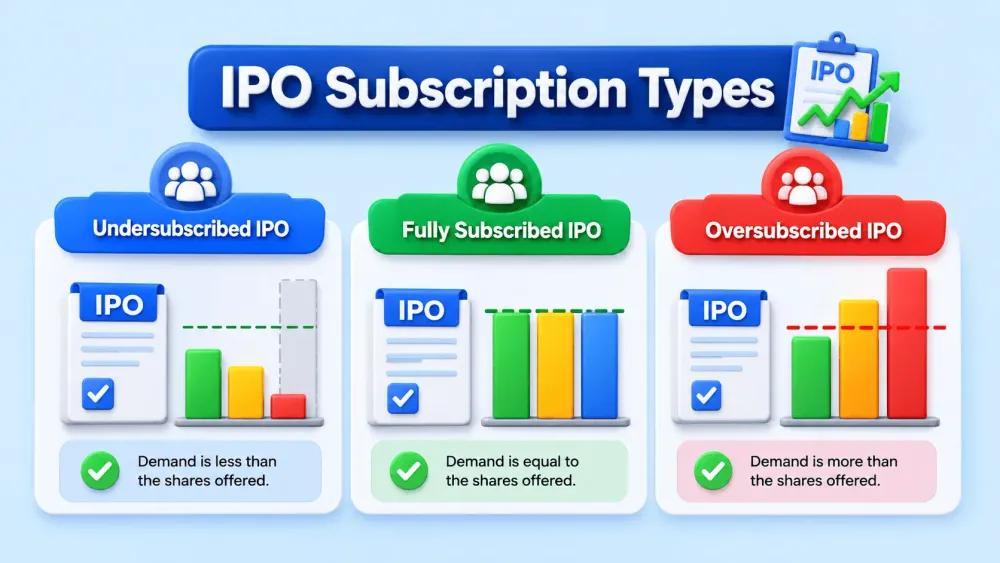
Undersubscribed IPO
An IPO is considered undersubscribed when investors apply for fewer shares than those offered.
For example, if a company offers 10 lakh shares but receives applications for only 7 lakh shares, the subscription is 0.7x.
Fully Subscribed IPO
A fully subscribed IPO means investor applications exactly match the number of shares available.
If 10 lakh shares are offered and applications are received for 10 lakh shares, the subscription is 1x.
Oversubscribed IPO
An IPO becomes oversubscribed when investors apply for more shares than are available.
For example, if investors apply for 100 lakh shares against an offer of 10 lakh shares, the IPO is subscribed 10 times (10x).
Oversubscription often reflects strong investor demand, but it also reduces the chances of receiving an allotment, especially in the retail category.
How Subscription is Calculated
Many first-time investors see terms like 5x subscription or 25x subscription and wonder how these numbers are calculated. The calculation is actually quite simple.
The IPO subscription ratio is calculated by dividing the total number of shares applied for by the total number of shares offered in that category.
Formula: IPO Subscription = Total Shares Applied ÷ Total Shares Offered
For example, suppose a company offers 50 lakh shares to retail investors. If investors submit applications for 2 crore shares, the retail category subscription would be:
2 crore ÷ 50 lakh = 4 times (4x)
The same calculation is done separately for the Retail Individual Investor (RII), Non-Institutional Investor (NII), and Qualified Institutional Buyer (QIB) categories. This is why you may see different subscription figures for each category.
Understanding these numbers can help you interpret investor demand, but they should not be the sole basis for your investment decision. A well-subscribed IPO may still underperform after listing if the company's fundamentals are weak or its valuation is expensive.
How to Check IPO Subscription Status
If you've applied for an IPO or want to monitor investor interest, knowing how to check IPO subscription status is important. Subscription data is updated several times during the IPO bidding period, allowing investors to track demand across different categories.
You can check IPO subscription status through:
- Stock exchanges: The NSE and BSE publish live subscription data for all active IPOs.
- IPO registrar: Registrars such as KFin Technologies and MUFG Intime India (formerly Link Intime India) display subscription details and, later, allotment status.
- Broker apps and websites: Most stockbrokers provide real-time subscription updates directly within their IPO section.
- Financial news websites: Many financial portals regularly update subscription figures throughout the day.
If you want to know whether you have received shares, you should check the IPO allotment status after the registrar announces the allotment. Subscription status only shows investor demand and does not indicate whether shares have been allotted to you.
What is a Good IPO Subscription?
No fixed number defines a "good" IPO subscription. In general, a subscription above 1x means the IPO has received applications for all the shares on offer.
However, experienced investors often look beyond the overall subscription figure. They also examine how each investor category has responded.
For example, if the QIB category attracts strong participation, it may indicate that institutional investors have confidence in the company's prospects. Similarly, healthy participation from retail investors shows broad market interest.
That said, a highly oversubscribed IPO is not always a good investment. Some IPOs receive strong demand due to positive market sentiment but may deliver modest listing gains or underperform in the long run. Before investing, consider factors such as the company's financial performance, business model, competitive position, growth potential, and valuation instead of relying only on subscription numbers.
Common Reasons for IPO Application Rejection
Sometimes, investors do not receive an allotment because their application is rejected rather than because of oversubscription. Some common reasons include:
- Entering an incorrect PAN, Demat account number, or DP ID
- Insufficient funds in the linked bank account
- Failing to approve the UPI mandate before the deadline
- Applying for multiple retail applications using the same PAN
- Applying for fewer or more shares than the permitted lot size
- Submitting the application after the IPO closes
- Technical errors or incomplete application details
To avoid rejection, carefully review all details before submitting your application and complete the UPI mandate approval on time.
Conclusion
IPO subscription figures can provide valuable insights into investor demand, but they should not be the sole basis for your investment decision. While strong subscription may indicate positive market interest, it's equally important to evaluate the company's financial performance, business model, risks, and valuation.
Additionally, knowing how IPO subscription works and how to check IPO subscription status helps you stay informed throughout the application process. Combining subscription data with fundamental analysis can help you make more informed investment decisions over the long term.
FAQs
What is IPO subscription?
IPO subscription refers to the total demand for shares offered in an IPO. It shows how many times investors have applied for the shares compared to the number of shares available.
What is the minimum subscription for IPO?
As per SEBI regulations, an IPO generally needs to receive at least 90% subscription of the net offer to proceed. If this minimum level is not achieved (except in certain book-built issues with underwriting arrangements), the issue may be withdrawn and the application money is refunded to investors.
How to check IPO subscription status?
You can check IPO subscription status on the NSE or BSE websites, the IPO registrar's website (such as KFin Technologies or MUFG Intime India), your broker's app, or financial news websites that provide live subscription updates.
What is a retail subscription in an IPO?
Retail subscription in an IPO represents the demand for shares reserved for Retail Individual Investors (RIIs). It shows how many times the retail portion has been subscribed to.
What happens if IPOs get oversubscribed?
When an IPO is oversubscribed, investors apply for more shares than are available. In such cases, shares are allotted according to SEBI's allotment rules, and many applicants may receive only partial allotment or no shares at all.
What happens if an IPO is under-subscribed?
If an IPO is under-subscribed, it means investor demand is lower than the number of shares offered. Depending on the level of subscription and applicable regulations, the issue may proceed, receive support from underwriters, or be withdrawn.
How much IPO subscription is good?
There is no ideal subscription number. A subscription above 1x indicates full demand, while stronger participation across retail, NII, and QIB categories may reflect positive investor interest. However, investment decisions should also consider the company's fundamentals.
Which category matters most in IPO subscription?
All categories are important, but many investors pay close attention to the QIB category because institutional investors usually conduct detailed research before investing. At the same time, strong participation from retail and NII categories also reflects broad market interest.
Can I sell an IPO the same day?
Yes. Once the shares are credited to your Demat account and the stock is listed on the exchange, you can sell them on the listing day if you wish.
Can I check IPO subscription status in real time?
Yes. During the subscription period, the NSE, BSE, broker platforms, and financial websites regularly update subscription figures throughout the trading day.
Where can I check if my application was allotted shares?
You can check your IPO allotment status on the website of the IPO registrar, such as KFin Technologies or MUFG Intime India, or through your broker. You can also verify whether the shares have been credited to your Demat account after the allotment process is completed.
Disclaimer: This article is for informational and educational purposes only and should not be considered investment or financial advice. Please conduct your own research or consult a qualified financial advisor before investing in an IPO.
Related Blog


Natural Gas Price Prediction for Next Week (19th October - 23th October 2026) Support 2 Support 1 CMP Resistance 1 Resistance 2 274 285 298.50 307 319 NYMEX Natural gas prices fell over 3% on Friday to $3.11/MMBtu, their lowest in more than a week, and lost around 3% for the week. Milder-than-normal weather through October 29 is expected to limit heating and cooling demand, pressuring prices. EIA storage rose 67 bcf, below forecasts and the five-year average of 90 bcf despite Middle
16 October 2026

Crude Oil Price Forecast for Next Week (19th October- 23th October 2026) Support 2 Support 1 CMP Resistance 1 Resistance 2 8800 9140 9573 9620 9920 WTI Crude oil prices surged above $100 per barrel, gaining over 11% for the week amid tightening global supply and strong shipping-sector fuel demand. Iranian strikes on tankers in the Strait of Hormuz disrupted oil flows, with average daily shipments falling to 11.62 million barrels in the week to October 13, against a baseline of 17.15
16 October 2026

Copper Price Forecast for Next Week (19th October- 23th October 2026) Support 2 Support 1 CMP Resistance 1 Resistance 2 1370 1389.30 1402.30 1432.20 1450 LME Copper prices declined 1.33% over the week as US dollar strength, interest-rate hike concerns and fears of a slowdown in Al-related capital expenditure weighed on market sentiment. The International Copper Study Group forecasts refined copper surpluses of 96,000 tonnes in 2026 and 377,000 tonnes in 2027, while China's smelting c
16 October 2026
Made for Traders.
Trusted by Investors.
Download FinX — trade confidently, invest
smarter, track everything.
Table of Contents

- What is an IPO Subscription?
- How IPO Subscription Works
- The Three Investor Categories
- IPO Subscription Process
- IPO Subscription Timing
- IPO Subscription Charges
- IPO Subscription Types
- How Subscription is Calculated
- How to Check IPO Subscription Status
- What is a Good IPO Subscription?
- Common Reasons for IPO Application Rejection
- Conclusion
- FAQs