

If you are trying to understand weekly options and how traders use them in the stock market, you are not alone. With the growing popularity of F&O (Futures and Options) trading in India, many retail traders are exploring weekly expiry options to take advantage of short-term market movements.
Unlike traditional options that expire once a month, weekly options expire every week. This shorter time frame creates more frequent trading opportunities and allows traders to respond quickly to market trends or important events. Because of this flexibility, weekly expiry options are commonly used by traders who follow the market closely and look for short-term opportunities.
However, since the expiry period is very short, option prices can change rapidly. This blog will help you understand how weekly expiry options work and what influences their prices, which is important before placing any trade.
What are Weekly Expiry Options?
Weekly expiry options are options contracts that expire every week rather than once a month. These contracts allow traders to speculate on short-term market movements within a limited time frame.
In India, options contracts generally expire on a specific weekday depending on the exchange and underlying asset. If the expiry day falls on a market holiday, the expiry is shifted to the previous trading day.
For example, imagine a trader expects the Nifty index to rise within the next few days. Instead of buying a monthly option that expires weeks later, they can trade weekly options that expire in the same week. This allows them to benefit from quick price movements.
Weekly expiry options are commonly available for major indices and some liquid stocks. The shorter duration means time value decreases faster, which significantly impacts option pricing.
Because of their short life span, weekly options are widely used for:
- Short-term market speculation
- Intraday trading strategies
- Event-based trading, such as RBI policy announcements or budget day
- Hedging positions in the market
For many active traders, weekly expiry options provide frequent trading opportunities within a single month, making them an important part of the derivatives market.
Why Traders Use Weekly Expiry Options
Many traders prefer weekly expiry options because they allow quick participation in short-term market movements. Compared to monthly contracts, weekly options provide more flexibility and frequent opportunities to trade.
One major reason traders use weekly options is the lower premium cost. Since these contracts have a shorter time until expiry, the option premium is often cheaper. This allows traders to take positions with relatively smaller capital.
Another reason is the fast price movement. As the expiry date approaches, the value of options changes rapidly due to time decay and market volatility. This creates opportunities for traders who rely on quick entry and exit strategies.
Weekly expiry options are also popular during major market events such as:
- RBI monetary policy announcements
- Union Budget
- Global market news
- Corporate results
For example, if a trader expects the market to move sharply during an event, trading weekly options can provide a way to capitalise on that movement within a short period.

Popular Weekly Expiry Options Trading Strategies
Because of their short duration, weekly options are often used with specific trading strategies designed for quick market movements.
1. Buying Call or Put Options
This is one of the simplest strategies used by beginners.
- Traders buy a call option when they expect the market to rise.
- Traders buy a put option when they expect the market to fall.
For example, if Nifty is trading at 22,000 and a trader expects it to move up within a few days, they may buy a 22,100 call option expiring that week.
2. Option Selling
Experienced traders often sell weekly options to benefit from time decay. Since options lose value as expiry approaches, sellers aim to collect the premium while the option gradually loses value.
However, option selling involves higher risk and requires proper risk management.
3. Straddle Strategy
In this strategy, traders buy both:
- A call option
- A put option
with the same strike price and expiry. This strategy is useful when traders expect a big market movement but are unsure of the direction.
4. Iron Condor Strategy
This is a popular strategy used by traders who expect the market to remain range-bound during the week. It involves selling and buying multiple options to create a limited risk and limited reward structure.

Benefits of Trading in Weekly Expiry Options
Trading weekly expiry options offers several advantages, especially for active traders.
1. More Trading Opportunities
Since contracts expire every week, traders get multiple chances to trade instead of waiting for a monthly expiry.
2. Lower Capital Requirement
Weekly options often have lower premiums, making them more accessible for small traders.
3. Faster Profit Potential
Because prices move quickly near expiry, traders can potentially generate profits within a short time frame.
4. Useful for Hedging
Investors can use weekly options to protect their portfolios against short-term market volatility.
For example, an investor holding stocks may buy a put option for the week to protect against a temporary market fall.
Risks of Trading Weekly Expiry Options
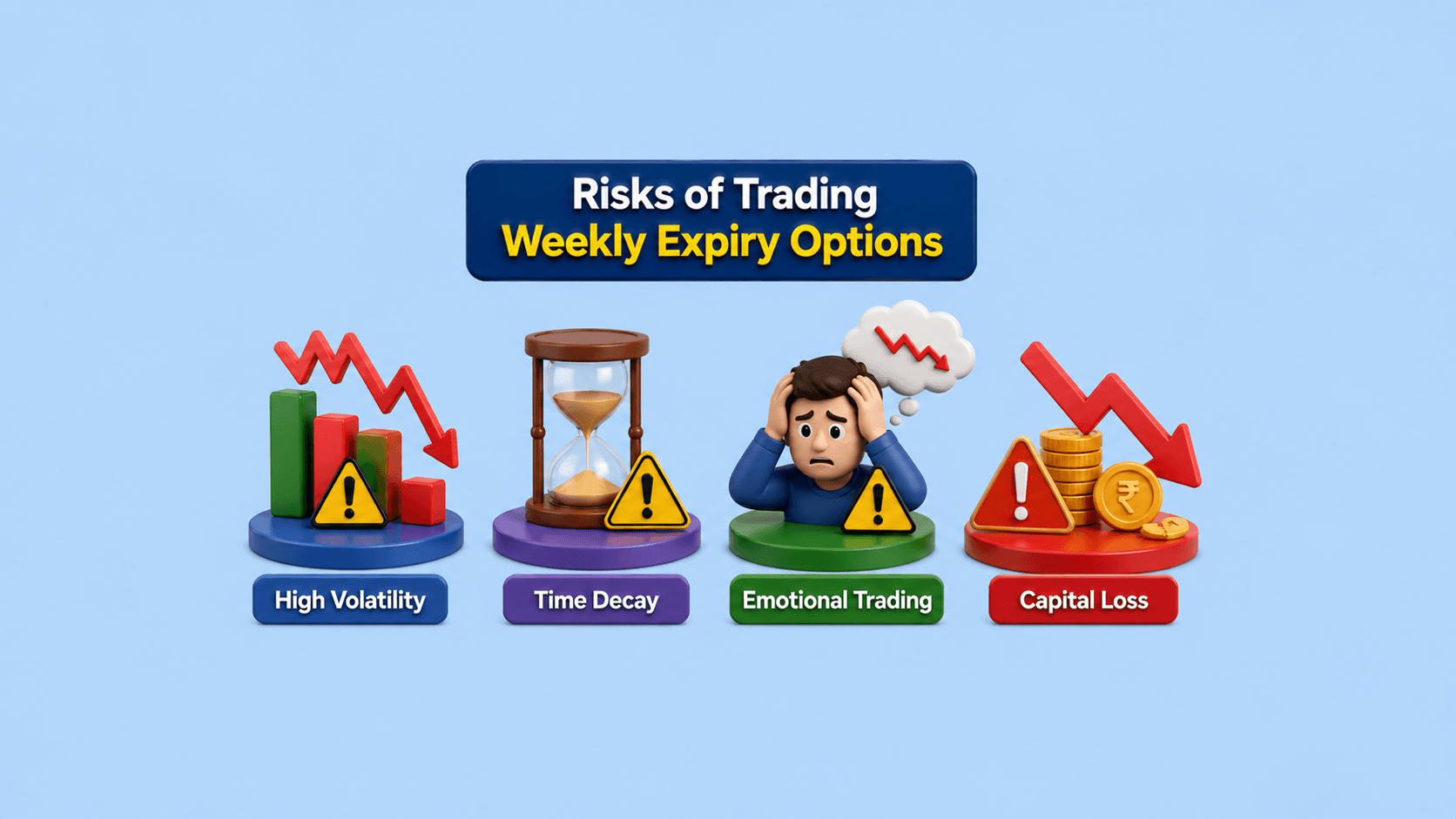
Despite their advantages, weekly options trading carries significant risks, especially for inexperienced traders.
1. High Volatility
Prices can change rapidly within minutes, leading to quick gains or losses.
2. Time Decay
Options lose value as the expiry date approaches. This is known as theta decay, and it accelerates sharply in weekly options.
3. Emotional Trading
Because movements happen quickly, traders may make impulsive decisions without proper analysis.
4. Capital Loss
If the market moves against the trader, the option premium may fall to zero by expiry.
For this reason, traders should always use proper risk management and position sizing.
Factors That Affect Weekly Expiry Options Prices
Several factors influence the price of weekly expiry options in the market.
1. Underlying Asset Price
The most important factor is the price movement of the underlying asset, such as Nifty, Bank Nifty, or a specific stock.
2. Time to Expiry
As the expiry date gets closer, the time value of the option decreases rapidly.
3. Market Volatility
Higher volatility increases option premiums because there is a greater chance of large price movements.
4. Interest Rates
Changes in interest rates can influence option pricing to some extent.
5. Market Events
Events like economic announcements, global news, or corporate earnings can lead to sudden price changes.
Tips for Trading Weekly Expiry Options
For beginners, trading weekly options without a plan can be risky. Following a few practical tips can help improve trading discipline.
1. Start with a Small Capital
New traders should begin with smaller positions until they gain experience.
2. Focus on Liquid Contracts
Trading options with higher liquidity ensures better entry and exit prices.
3. Use Stop Loss Orders
A stop loss helps limit losses when the market moves against the trade.
4. Avoid Overtrading
Weekly options provide frequent opportunities, but taking too many trades can increase risk.
5. Learn Basic Option Strategies
Understanding strategies like spreads, straddles, and hedging can help manage risk more effectively.
Example of a Weekly Expiry Options Trade
Let’s look at a simple example to understand how a weekly options trade works.
Suppose Nifty is trading at 22,000 on Monday.
A trader believes the index will rise before the weekly expiry on Thursday.
- The trader buys a 22,100 call option at ₹50 premium.
- Each lot size is 50 units.
So the total investment becomes: ₹50 × 50 = ₹2,500
If Nifty rises to 22,200 before expiry, the option premium may increase to ₹120.
The trader can sell the option and earn: ₹120 × 50 = ₹6,000
Profit = ₹6,000 − ₹2,500 = ₹3,500
However, if the market does not move as expected, the premium may fall significantly, resulting in a loss.
Conclusion
Weekly options have become an important part of India's derivatives market, offering traders frequent opportunities to participate in short-term market movements. While weekly expiry options can provide flexibility and profit potential, they also involve significant risks due to rapid price fluctuations and time decay.
Understanding how these contracts work, the factors that influence their prices, and the strategies commonly used in the F&O segment can help traders make more informed and disciplined trading decisions.
FAQs
What Are Weekly Options?
Weekly options are options contracts that expire every week instead of once a month. They allow traders to take positions based on short-term market expectations.
Which Options Have a Weekly Expiry in India?
In India, several index options such as Nifty, Bank Nifty, and other major indices offer weekly expiry contracts on stock exchanges.
Are Weekly or Monthly Options Better?
Both have their advantages. Weekly options are better for short-term trading and event-based strategies, while monthly options are often preferred by traders who want more time for their market view to play out.
Disclaimer: The information provided in this article is for informational purposes only and does not constitute investment advice. Trading in derivatives involves risk, and investors should conduct their own research before investing.
Related Blog


The overall month has been quite unpredictable. While many on the chart stood strong, most of them have slipped. Bank Nifty on the other hand maintained its grip for a long time but now appears slightly bearish. Let’s see what the coming month holds for the investors as Mr. Sumeet Bagadia, Executive Director of Choice takes us through the weekly predictions of the market. Nifty Prediction For Next Week (24th August - 28th August 2026) The Nifty 50 witnessed a volatile week, with selling press
21 August 2026

Prism, the parent company of global travel-tech unicorn OYO, has moved closer to its proposed stock market debut after receiving clearance from the Securities and Exchange Board of India (SEBI), filing its Updated Draft Red Herring Prospectus (UDRHP), and beginning its roadshow for a proposed ₹6,650 crore initial public offering (IPO). The company, which is led by Ritesh Agarwal, has started meeting institutional investors as it prepares for its public-market debut later this year. The proposed
21 August 2026

FII DII Data Today 21th August 2026 CATEGORY DATE BUY VALUE (₹ Crores) SELL VALUE (₹ Crores) NET VALUE (₹ Crores) DII 21-Aug-2026 13,209.23 11,599.76 1,609.47 FII 21-Aug-2026 11,634.11 11,769.68 -135.57 What are FII and DII in the Stock Market Foreign Institutional Investors (FIIs) invest in the Indian stock market from international markets, while Domestic Institutional Investors (DIIs) include mutual funds and institutional bodies operating from India. fii dii data helps track
20 August 2026
Made for Traders.
Trusted by Investors.
Download FinX — trade confidently, invest
smarter, track everything.
Table of Contents

- What are Weekly Expiry Options?
- Why Traders Use Weekly Expiry Options
- Popular Weekly Expiry Options Trading Strategies
- Benefits of Trading in Weekly Expiry Options
- Risks of Trading Weekly Expiry Options
- Factors That Affect Weekly Expiry Options Prices
- Tips for Trading Weekly Expiry Options
- Example of a Weekly Expiry Options Trade
- Conclusion
- FAQs