
If you’ve ever placed a trade and noticed that the price at which your order got executed is slightly different from the price you expected, you’ve already experienced slippage even if you didn’t know the term at the time.
For many everyday investors in India, especially those trading through platforms regulated by the Securities and Exchange Board of India, this can feel confusing or even frustrating. You see one price on your screen, but your trade happens at another. Naturally, the first question that comes to mind is: Where did that difference come from?
Understanding the slippage meaning in trading is not just for advanced traders. Whether you’re investing ₹500 or ₹5 lakh, slippage directly affects your profits and losses. In this guide, we’ll break down everything from what slippage is to why it happens and, most importantly, how you can reduce it in real trading situations.
What Exactly Is Slippage?
In simple terms, slippage is the difference between the expected price of a trade and the actual price at which the trade is executed.
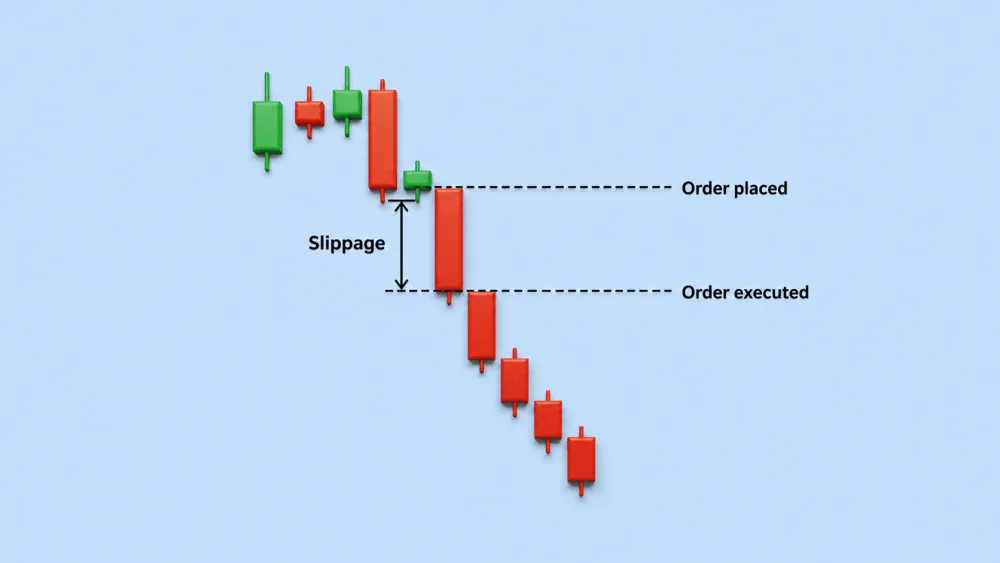
This usually happens in fast-moving markets where prices change in fractions of a second. So even if you click “buy” at ₹100, by the time your order reaches the exchange, the price might have moved to ₹100.20 or ₹99.80.
In this case, the difference of ₹0.20 is called slippage.
Another way to understand the meaning of slippage is:
Slippage = Expected Price - Executed Price
There’s also something called a slippage ratio, which helps traders measure how much slippage occurs relative to the trade size. While beginners may not calculate it daily, it becomes useful for tracking performance over time.
Example
Let’s take a real-life example that many Indian traders can relate to:
You place a market order to buy shares of a company at ₹1,000.
- Expected price: ₹1,000
- Actual execution price: ₹1,002
Your slippage = ₹2 per share
Now imagine you bought 100 shares:
- Total extra cost = ₹200
This may not seem huge at first, but if you trade frequently, this adds up significantly over time. This is how slippage trading silently eats into your returns.
The Reason It Happens:
Slippage doesn’t happen randomly; it’s caused by specific market conditions and technical factors.
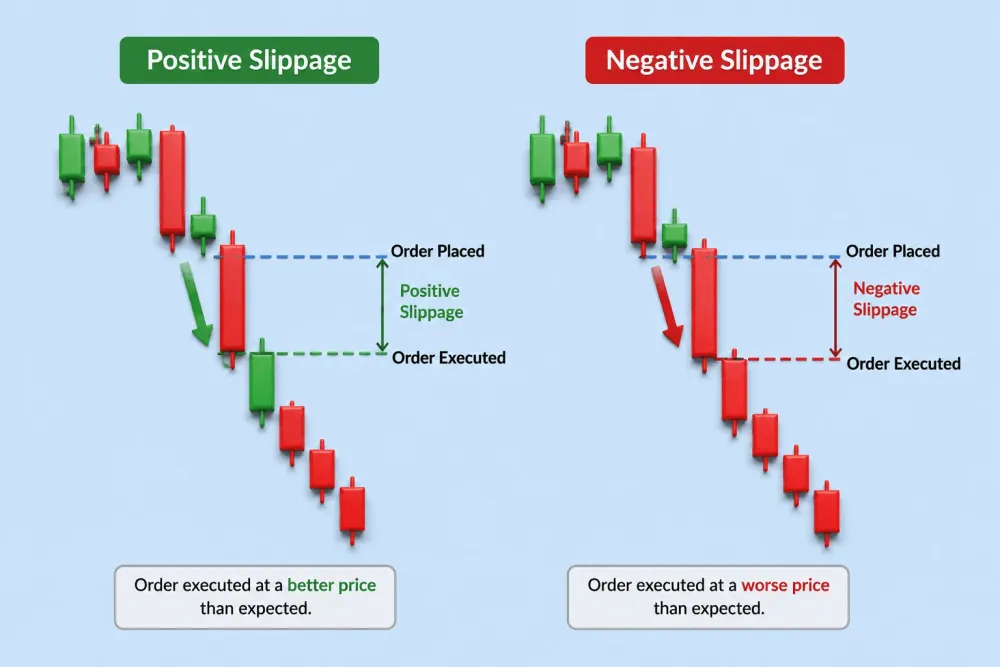
Positive Slippage
Positive slippage occurs when you get a better price than expected.
For example:
- You planned to buy at ₹500
- Your order executes at ₹498
Here, you saved ₹2 per share. This is less common but definitely beneficial.
Negative Slippage
Negative slippage is more common and happens when you get a worse price than expected.
For example:
- You planned to buy at ₹500
- Your order executes at ₹503
Now you’re paying more, which reduces your profit potential.
Why Does Slippage Happen?
Market Volatility
During events like budget announcements, election results, or global market shocks, prices move extremely fast. In such situations, even a delay of milliseconds can cause noticeable time slippage where your order execution lags behind price movement.
Low Liquidity
Liquidity means how easily you can buy or sell a stock without affecting its price. Stocks with low trading volume often have fewer buyers and sellers, which increases the chances of slippage.
Large Order Sizes
If you place a big order, the market may not have enough sellers at your desired price. So your order gets filled at multiple price levels, increasing overall slippage.
Order Type: Market vs. Limit
- Market Orders: Execute instantly but are more prone to slippage
- Limit Orders: Execute only at your chosen price, reducing slippage risk
Execution Speed & Broker Latency
Even with modern platforms, there’s always a small delay between placing an order and execution. This delay, combined with fast price movement, causes slippage.
Slippage Across Different Markets
Slippage exists in all markets, but its impact varies:
- Stock Market (NSE/BSE): Moderate slippage, especially in mid/small caps
- Commodity Market (MCX): Higher volatility can lead to more slippage
- Crypto (DEX platforms): Slippage can be very high due to liquidity issues
Platforms connected with systems like CAMS and KFintech ensure smoother processing in mutual fund transactions, but direct market trades still face slippage depending on conditions.
How Volatility and Liquidity Affect Slippage
Think of volatility and liquidity like traffic on a road:
- High liquidity = smooth highway → less slippage
- Low liquidity = narrow road → more slippage
- High volatility = sudden traffic jams → unpredictable slippage
When both low liquidity and high volatility combine, slippage increases sharply.
How Slippage Changes Actual Profit and Loss
Slippage directly impacts your final returns.
Let’s say:
- Expected profit per trade: ₹500
- Slippage cost: ₹100
Your real profit becomes ₹400.
Over 100 trades:
- Total loss due to slippage = ₹10,000
This is why serious traders track their slippage ratio and adjust strategies accordingly.
How to Actually Reduce Slippage
Use Limit Orders, Not Market Orders
Limit orders give you control over price, making them one of the most effective ways to reduce slippage.
Trade During Peak Liquidity Hours
In India, liquidity is highest:
- Morning session (9:15 AM – 11:30 AM)
- Near market close
Avoid midday dull hours where price movement is inconsistent.
Set Slippage Tolerance on DEX Platforms
If you trade crypto, you can set a maximum acceptable slippage percentage. This prevents trades from executing beyond your comfort level.
Break Up Large Orders (TWAP Strategy)
Instead of placing one big order, divide it into smaller parts over time. This reduces market impact and improves average execution price.
Avoid Trading Around Major News Events
Big announcements create sudden volatility. Unless you’re experienced, it’s better to wait until the market stabilizes.
Stick to Liquid Instruments
Focus on stocks with high daily volume (like Nifty 50 stocks). These have tighter spreads and lower slippage.
Track Your Own Slippage Data
Maintain a simple record:
- Expected price
- Executed price
- Difference
Over time, you’ll understand patterns and improve your strategy.
Slippage vs Bid-Ask Spread
Many beginners confuse slippage with the bid-ask spread.
- Bid-Ask Spread: The difference between the buying and selling prices at a given moment
- Slippage: The difference caused during execution
Both impact your cost, but they are not the same.
Conclusion
Slippage may seem like a minor detail, but it can quietly affect your overall returns in a meaningful way. By keeping track of your trades and making simple changes such as using limit orders and choosing the right time to trade, you can improve your execution and protect your profits.
As more individuals across India participate in the stock market, having clarity on concepts like slippage can help you make more informed and disciplined trading decisions.
FAQs
What is slippage in trading?
Slippage is the difference between the expected price of a trade and the actual execution price. It usually occurs due to fast price movements or low liquidity.
What causes slippage in the stock market?
Slippage is mainly caused by volatility, low liquidity, large order sizes, and the use of market orders.
How can traders reduce slippage?
Traders can reduce slippage by using limit orders, trading during high-liquidity hours, avoiding news events, and choosing liquid stocks.
Can slippage be avoided completely?
No, slippage cannot be completely avoided. However, with the right strategies, it can be minimized significantly.
Disclaimer: This article is for educational purposes only and should not be considered financial advice. Please consult a SEBI-registered financial advisor before making any investment decisions.
Related Blog


Natural Gas Price Prediction for Next Week (19th October - 23th October 2026) Support 2 Support 1 CMP Resistance 1 Resistance 2 274 285 298.50 307 319 NYMEX Natural gas prices fell over 3% on Friday to $3.11/MMBtu, their lowest in more than a week, and lost around 3% for the week. Milder-than-normal weather through October 29 is expected to limit heating and cooling demand, pressuring prices. EIA storage rose 67 bcf, below forecasts and the five-year average of 90 bcf despite Middle
16 October 2026
Crude Oil Price Forecast for Next Week (19th October- 23th October 2026) Support 2 Support 1 CMP Resistance 1 Resistance 2 8800 9140 9573 9620 9920 WTI Crude oil prices surged above $100 per barrel, gaining over 11% for the week amid tightening global supply and strong shipping-sector fuel demand. Iranian strikes on tankers in the Strait of Hormuz disrupted oil flows, with average daily shipments falling to 11.62 million barrels in the week to October 13, against a baseline of 17.15
16 October 2026

Copper Price Forecast for Next Week (19th October- 23th October 2026) Support 2 Support 1 CMP Resistance 1 Resistance 2 1370 1389.30 1402.30 1432.20 1450 LME Copper prices declined 1.33% over the week as US dollar strength, interest-rate hike concerns and fears of a slowdown in Al-related capital expenditure weighed on market sentiment. The International Copper Study Group forecasts refined copper surpluses of 96,000 tonnes in 2026 and 377,000 tonnes in 2027, while China's smelting c
16 October 2026
Made for Traders.
Trusted by Investors.
Download FinX — trade confidently, invest
smarter, track everything.