

When you invest in the share market, evaluating a company's financial performance goes beyond looking at its share price or profits. Financial ratios like Return on Equity (ROE) and Return on Capital Employed (ROCE) help investors understand how efficiently a company generates returns from the money invested in its business.
Understanding ROCE vs ROE can help you make more informed investment decisions by revealing different aspects of a company's profitability and capital efficiency. In this article, we'll explain what ROE and ROCE are, the difference between ROCE and ROE, their formulas, examples, and when each ratio should be used while analysing stocks.
What is ROE in the Share Market?
Return on Equity (ROE) measures how efficiently a company uses shareholders' funds to generate profits. In simple terms, it shows how much profit a company earns for every rupee invested by its shareholders.
Understanding the ROE meaning in the stock market can help investors evaluate whether a company is creating value for its shareholders.
Formula:
ROE = Net Profit ÷ Shareholders' Equity × 100
For example, if a company earns a net profit of ₹100 crore and has shareholders' equity of ₹500 crore, its ROE will be 20%. This means the company generates ₹20 in profit for every ₹100 of shareholders' investment.
A higher ROE generally indicates better use of shareholders' funds. However, it should be analysed along with other financial metrics, as high debt can sometimes inflate the ratio.
What is ROCE in the Share Market?
ROCE (Return on Capital Employed) is a financial ratio that measures how efficiently a company uses its total capital, including both shareholders' equity and borrowed funds, to generate operating profits. It provides a broader view of a company's overall capital efficiency.
Formula:
ROCE = EBIT (Earnings Before Interest and Taxes) ÷ Capital Employed × 100
For example, if a company has an EBIT of ₹180 crore and capital employed of ₹900 crore, its ROCE will be 20%. This means the company earns ₹20 in operating profit for every ₹100 of capital employed.
A consistently high ROCE generally indicates efficient capital utilisation and is especially useful when evaluating capital-intensive businesses such as manufacturing, infrastructure, and power companies.
Difference Between ROE and ROCE
Although both ratios measure profitability and efficiency, there are important distinctions in the ROCE and ROE difference that every investor should understand.
| Basis | ROE | ROCE |
|---|---|---|
| Meaning | Measures returns generated from shareholders' equity | Measures returns generated from total capital employed |
| Capital Considered | Shareholders' equity only | Equity plus long-term debt |
| Profit Used | Net Profit | EBIT (Operating Profit) |
| Focus | Shareholder returns | Overall business efficiency |
| Best Used For | Companies with lower debt | Companies with significant debt or capital investment |
| Impact of Debt | Can be influenced by high borrowing | Gives a more balanced picture by considering debt |
The primary difference between ROCE and ROE is that ROE focuses only on shareholder wealth creation, while ROCE evaluates how efficiently the entire business uses all available capital.
Because of this, experienced investors usually analyse both ratios together instead of relying on only one metric.
Example of ROE and ROCE
Let's understand ROCE vs ROE using a simple example.
Imagine two companies operating in the same industry.
Company A
- Net Profit = ₹120 crore
- Shareholders' Equity = ₹600 crore
- EBIT = ₹180 crore
- Capital Employed = ₹900 crore
ROE = (120 ÷ 600) × 100 = 20%
ROCE = (180 ÷ 900) × 100 = 20%
Now consider another company.
Company B
- Net Profit = ₹120 crore
- Shareholders' Equity = ₹300 crore
- EBIT = ₹180 crore
- Capital Employed = ₹1,200 crore
ROE = (120 ÷ 300) × 100 = 40%
ROCE = (180 ÷ 1,200) × 100 = 15%
At first glance, Company B appears more attractive because its ROE is much higher. However, its lower ROCE suggests that the company relies heavily on borrowed funds, making overall capital utilisation less efficient.
This example shows why understanding what ROE and ROCE together provide a more complete view of a company's financial health.
When to Use ROE vs ROCE?
Choosing between ROE and ROCE depends on the type of company you are analysing and the insights you want to gain.
Use ROE when:
- You want to evaluate returns generated specifically for shareholders.
- You are comparing companies with relatively low debt.
- You are analysing financial institutions such as banks and NBFCs, where ROE is widely used.
Use ROCE when:
- You want to measure overall business efficiency.
- You are analysing manufacturing, infrastructure, power, or capital-intensive businesses.
- You want to understand how efficiently management uses both equity and borrowed funds.
For most long-term investors, using both ratios together provides better insights. A company with consistently healthy ROE and ROCE over several years often indicates strong management, efficient capital allocation, and sustainable profitability.
While these ratios are valuable, they should also be analysed alongside debt levels, revenue growth, cash flows, profit margins, corporate governance, and disclosures available in annual reports and regulatory filings with SEBI.
Conclusion
Understanding ROCE vs ROE helps investors move beyond simply looking at profits or share prices. Both ratios measure efficiency, but they evaluate different aspects of a company's financial performance. ROE focuses on returns generated for shareholders, whereas ROCE measures how efficiently the company uses its total capital, including borrowed funds.
Instead of relying on a single financial ratio, investors should compare both metrics over multiple years and against industry peers. Combining ROE and ROCE with other financial indicators, management quality, and business fundamentals can help build a more informed investment strategy before you invest in the share market.
FAQs
Which is better ROCE or ROE?
Neither ratio is universally better. ROE is useful for understanding shareholder returns, while ROCE provides a broader picture of overall capital efficiency. Analysing both together generally offers better insights into a company's financial performance.
What do ROCE & ROE indicate about a company?
ROE indicates how efficiently a company generates profits from shareholders' investments, whereas ROCE measures how effectively it uses both equity and borrowed funds to generate operating profits. Together, these ratios help investors assess profitability, capital efficiency, and management performance.
Can a company have a high ROCE and a low ROE?
Yes. A company may report a high ROCE but a relatively low ROE if it has a large equity base or lower net profits despite strong operating performance. Similarly, a company with significant debt may report a high ROE while having a lower ROCE. This is why investors should evaluate both ratios together rather than relying on a single metric.
Disclaimer: This article is for educational purposes only and should not be considered investment or financial advice. Please conduct your own research before investing.
Related Blog


Nifty Prediction For Tomorrow Indian equities remained under pressure on 21 October, with the Nifty closing at 22,811.35, down 77.60 points (-0.34%), marking its second consecutive session of decline. The index opened higher at 23,016, a gap-up of around 127 points, and initially advanced to an intraday high of 23,120.90 within the first half-hour. However, selling pressure emerged soon after the early rise and dragged the index down to an intraday low of 22,649.90. A late recovery helped the i
20 October 2026
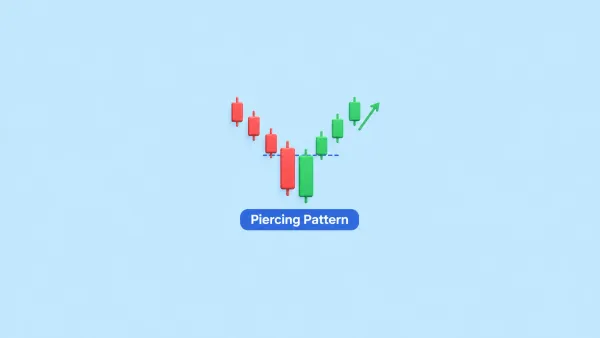
Understanding candlestick patterns can help traders study price movements and identify possible changes in market direction. One such pattern is the Piercing Pattern, which may signal a shift from selling pressure to buying pressure after a price decline. The pattern consists of two candles and is commonly used in technical analysis to identify a possible bullish reversal. However, it does not guarantee that prices will rise. Traders usually look for confirmation from the following candles, tr
14 October 2026

Key Takeaways * An ETF holds a basket of securities and trades on a stock exchange like a share. * Most ETFs in India are passively managed — they aim to copy an index, a commodity like gold or another benchmark, rather than try to beat it. * Returns can differ a little from the benchmark, because of expenses, cash holdings, transaction costs, portfolio adjustments and the fund’s replication method. * You need a demat and trading account to buy and sell ETF units. * ETFs are generally low-
13 October 2026
Made for Traders.
Trusted by Investors.
Download FinX — trade confidently, invest
smarter, track everything.