
When people start exploring the stock market, most conversations focus on equity shares, mutual funds, or IPOs. There’s another option called preferred stock that sits between safety and returns. Understanding what is preferred stock can help you discover a more balanced way to earn steady income without taking excessive market risk.
In simple terms, preferred stock meaning refers to a type of share that gives investors priority in receiving dividends compared to common shareholders. It combines features of both equity and fixed-income investments, making it suitable for all those who want stable returns while still participating in the stock market.
What is Preferred Stock
To understand what preferred stock is, consider a situation where a company raises money from investors but wants to reward some of them with more benefits. That’s where preferred shareholders come in.
Preferred stock is a special class of ownership in a company where investors receive fixed or predetermined dividends before any payments are made to common shareholders. However, in most cases, they do not get voting rights in company decisions.
For example, if a company earns profits and decides to distribute earnings, preferred shareholders will receive their share first. Only after that will common shareholders receive anything. This priority is what makes preferred stock appealing to conservative investors.
In India, such instruments are issued under guidelines from the Securities and Exchange Board of India, ensuring transparency and investor protection.
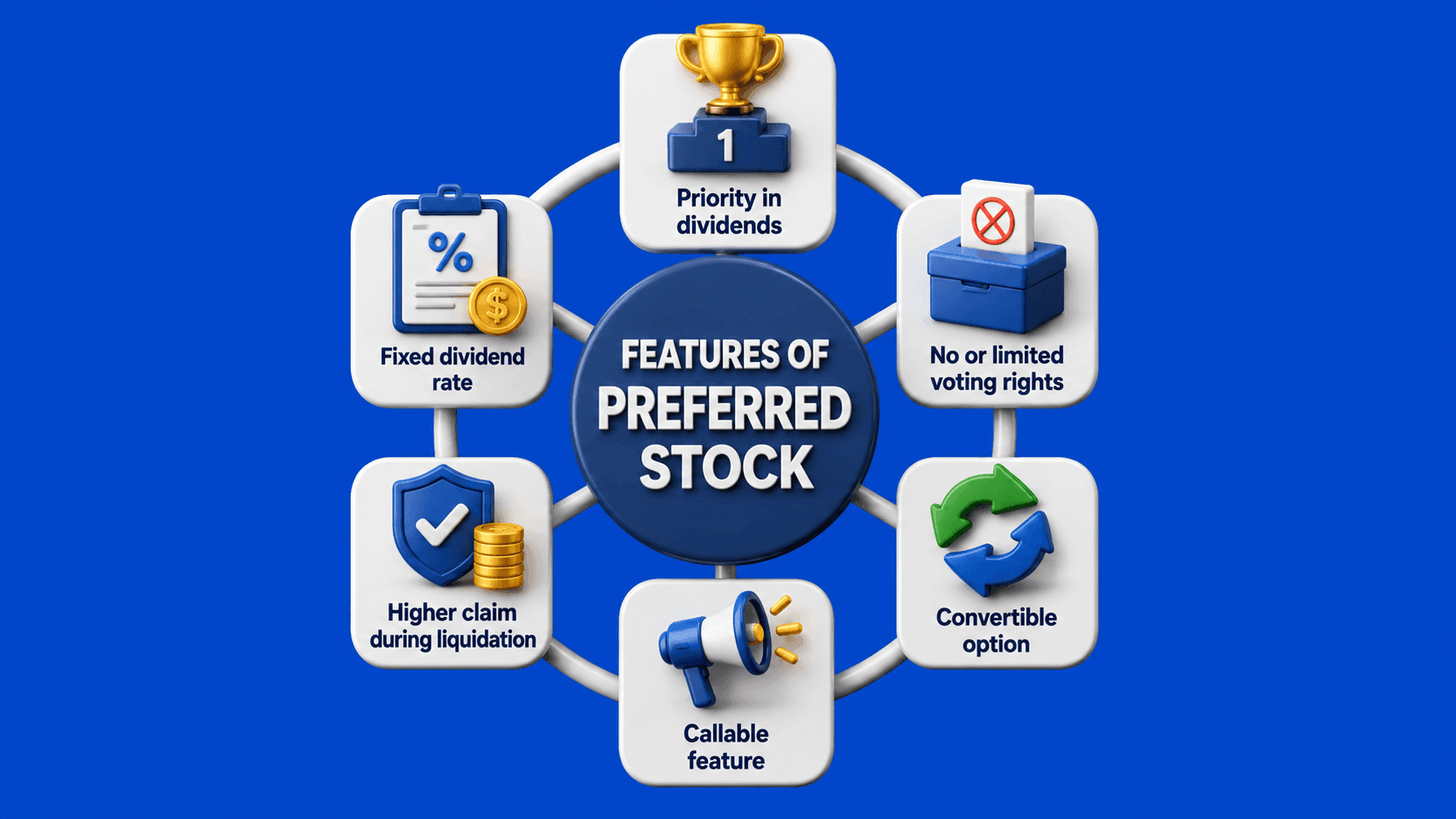
Features of Preferred Stock
Understanding the features of preferred stock helps you evaluate whether it fits your financial goals.
These features are what differentiate it from other investment options:
- Priority in dividends
Investors receive preferred stock dividends before common shareholders, making income more predictable. - Fixed dividend rate
Unlike equity shares, where dividends can fluctuate, preferred stocks often offer a fixed return. - No or limited voting rights
Investors usually don’t participate in company decision-making. - Higher claim during liquidation
If a company shuts down, preferred shareholders are paid before common shareholders. - Convertible option (in some cases)
Some types allow conversion into equity shares; this is known as what is convertible preferred stock. - Callable feature
Companies may buy back shares after a certain period.
These features make preferred stock a middle-ground option, less risky than common equity but not as secure as bonds.
Preferred Stock Dividends Explained
One of the main reasons investors consider this option is the preferred stock dividends. These dividends are usually fixed and declared as a percentage of the face value of the stock.
Let’s understand with a simple example:
If you invest ₹1,00,000 in preferred shares offering a 8% dividend, you can expect around ₹8,000 annually, subject to company performance and payout decisions.
This predictability is particularly attractive for individuals who rely on investments for regular income, such as retirees or families looking for stability.
Another important concept here is the cost of preferred stock. From a company’s perspective, it refers to the rate of return they must offer to attract investors. For investors, it helps in comparing returns with other options like bonds or fixed deposits.
Preferred Stock vs Common Stock: Key Differences
| Basis | Preferred Stock | Common Stock |
|---|---|---|
| Dividend Priority | Dividends are paid first to preferred shareholders. | Dividends are paid after the preferred shareholders. |
| Voting Rights | Usually, no or limited voting rights. | Generally have voting rights in company decisions. |
| Risk Level | Lower risk with more stable returns. | Higher risk due to market fluctuations. |
| Growth Potential | Limited growth, focused on steady income. | Higher growth potential with price appreciation. |
When comparing the difference between common stock and preferred stock, it becomes clear that one focuses on growth and ownership power, while the other focuses on income and stability.
Similarities Between Common Stock and Preferred Stock
Even though there are differences, there are also important similarities between common stock and preferred stock that investors should know.
Both types of shares:
- Represent ownership in a company
- Are traded in financial markets
- Can generate income through dividends
- Carry some level of risk depending on the company's performance
These similarities mean that both can be part of a diversified portfolio, depending on your financial goals and risk appetite.
Who Can Buy Preferred Stock
A common question among new investors is who can buy preferred stock. The answer is simple: any investor with a Demat account can invest, provided such shares are available in the market.
In India, preferred shares are less commonly traded compared to equity shares, but they can still be accessed through:
- Direct company offerings
- Private placements
- Secondary market (in limited cases)
For those exploring a preferred stock list, availability may vary depending on market conditions and company issuance.
Conclusion
Preferred stock is often overlooked, but it offers a unique balance between stability and returns. For investors who don’t want the uncertainty of regular equity markets but still want better returns than traditional savings options, it can be a valuable addition.
By understanding what preferred stock is, its features, and how it compares with equity shares, you can now make more informed decisions. Whether you’re just starting your journey with Stocks or looking to diversify your portfolio, preferred shares provide an option worth considering, especially if steady income is your priority.
FAQs
What is The Meaning of Preferred Stocks?
Preferred stock meaning refers to a type of share that gives investors priority in receiving dividends and company payouts compared to common shareholders, usually with fixed returns and limited voting rights.
Who can buy preferred stock?
Anyone with a Demat account can invest in preferred shares, although availability may depend on company issuance and market conditions.
What is convertible preferred stock?
What is convertible preferred stock refers to a type of preferred share that can be converted into a fixed number of common shares after a certain period, offering both stability and potential growth.
Disclaimer: This content is for informational purposes only and does not constitute investment advice. Please consult a financial advisor before investing in preferred stock or any other securities.
Related Blog


The overall month has been quite unpredictable. While many on the chart stood strong, most of them have slipped. Bank Nifty on the other hand maintained its grip for a long time but now appears slightly bearish. Let’s see what the coming month holds for the investors as Mr. Sumeet Bagadia, Executive Director of Choice takes us through the weekly predictions of the market. Nifty Prediction For Next Week (24th August - 28th August 2026) The Nifty 50 witnessed a volatile week, with selling press
21 August 2026
Prism, the parent company of global travel-tech unicorn OYO, has moved closer to its proposed stock market debut after receiving clearance from the Securities and Exchange Board of India (SEBI), filing its Updated Draft Red Herring Prospectus (UDRHP), and beginning its roadshow for a proposed ₹6,650 crore initial public offering (IPO). The company, which is led by Ritesh Agarwal, has started meeting institutional investors as it prepares for its public-market debut later this year. The proposed
21 August 2026

FII DII Data Today 21th August 2026 CATEGORY DATE BUY VALUE (₹ Crores) SELL VALUE (₹ Crores) NET VALUE (₹ Crores) DII 21-Aug-2026 13,209.23 11,599.76 1,609.47 FII 21-Aug-2026 11,634.11 11,769.68 -135.57 What are FII and DII in the Stock Market Foreign Institutional Investors (FIIs) invest in the Indian stock market from international markets, while Domestic Institutional Investors (DIIs) include mutual funds and institutional bodies operating from India. fii dii data helps track
20 August 2026
Made for Traders.
Trusted by Investors.
Download FinX — trade confidently, invest
smarter, track everything.