

Options trading is not always about predicting whether the market will move up or down. Some strategies focus on managing risk while seeking opportunities in changing market conditions. One such approach is the delta neutral strategy.
A delta-neutral trading strategy aims to reduce the impact of small price movements in the underlying asset by balancing positions using options, stocks, or futures. Widely used by professional traders and institutions, this strategy helps manage directional risk while potentially benefiting from factors such as time decay and changes in volatility.
In this guide, we'll explore what delta neutral is, how it works, popular delta neutral option strategies, the role of hedging, and the taxation of delta neutral trading in India.
What is the Delta Neutral Strategy?
A delta-neutral strategy is a trading approach where the total delta of a portfolio is close to zero. This means the portfolio is structured so that small movements in the price of the underlying asset have little to no impact on its value.
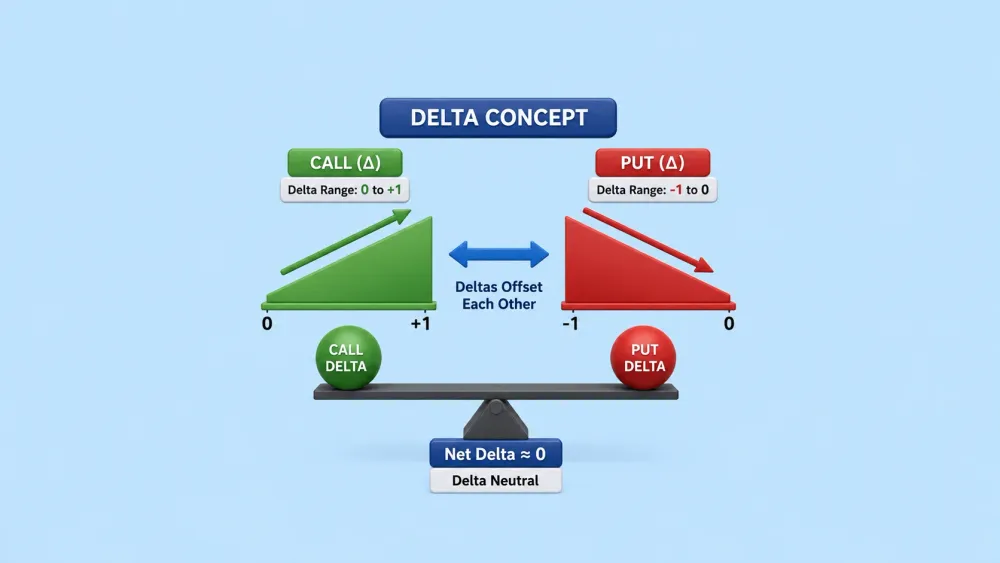
To understand what is delta neutral strategy, you first need to understand the term "delta."
Delta measures how much the price of an option changes when the underlying asset moves by ₹1.
For example:
- A call option with a delta of 0.50 may increase by approximately ₹0.50 if the underlying rises by ₹1.
- A put option with a delta of -0.50 may increase by approximately ₹0.50 if the underlying falls by ₹1.
When positive and negative deltas offset each other, the portfolio achieves delta neutrality.
What is the Delta Neutral Trading Strategy?
A delta-neutral trading strategy involves combining options, stocks, or future and option positions so that the net delta remains near zero.
The objective is not necessarily to predict market direction. Instead, traders seek to benefit from:
- Changes in implied volatility
- Time decay (theta)
- Mispricing in options
- Arbitrage opportunities
- Dynamic adjustments through hedging
For example, a trader expecting volatility to remain stable may construct a delta-neutral position to generate income while minimizing directional exposure.
This makes a delta-neutral option strategy particularly useful during uncertain market conditions.
How the Delta Neutral Strategy Works
Suppose you buy one call option on a stock with a delta of +0.50.
This means the option gains approximately ₹0.50 for every ₹1 increase in the stock price.
To create a delta-neutral position, you can offset this exposure by selling 50 shares of the stock.
Example:
- Buy 1 Call Option: Delta = +0.50
- Sell 50 Shares: Delta = -0.50
Net Delta = 0
As a result, small movements in the stock price may have a limited impact on the portfolio's value.
However, delta is not fixed. As prices move, option deltas change. Therefore, maintaining delta neutrality often requires periodic adjustments.
Key Concepts for Delta Neutral Trading
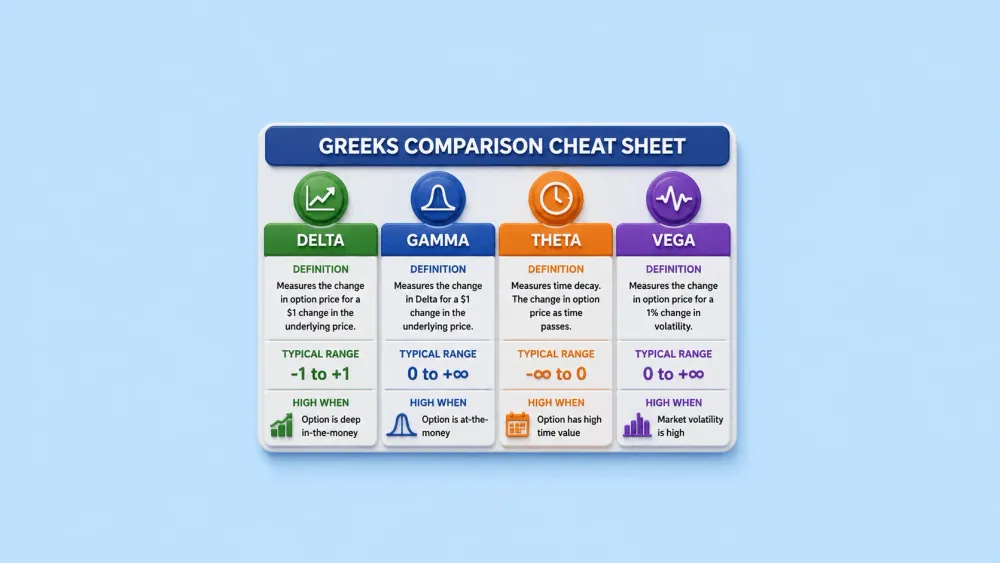
1. Delta
Delta measures sensitivity to changes in the underlying asset's price.
- Call options: Delta ranges from 0 to +1
- Put options: Delta ranges from -1 to 0
Understanding delta is essential before implementing any delta-neutral hedging strategy.
2. Gamma
Gamma measures how quickly delta changes when the underlying asset moves.
High gamma positions require more frequent rebalancing.
3. Theta
Theta represents time decay.
Many delta-neutral traders attempt to earn from theta while limiting directional risk.
4. Vega
Vega measures sensitivity to changes in implied volatility.
Volatility shifts can significantly impact the profitability of delta-neutral positions.
Popular Delta Neutral Strategies
Long Straddle
A trader buys:
- One ATM Call Option
- One ATM Put Option
This position can initially be adjusted to achieve delta neutrality.
It is commonly used when large price movements are expected but the direction is uncertain.
Short Straddle
A trader sells:
- One ATM Call
- One ATM Put
This strategy benefits from time decay but carries substantial risk if markets move sharply.
Iron Butterfly
The Iron Butterfly combines limited risk with income generation and is often used in range-bound markets.
Covered Call with Hedging
Investors holding shares may sell call options and use adjustments to move closer to delta neutrality.
Dynamic Delta Hedging
Among all delta-neutral strategies, this is one of the most widely used by institutions. Positions are adjusted continuously as delta changes.
Delta Hedging: The Engine Behind Neutrality
A delta-neutral hedging strategy depends heavily on delta hedging.
Delta hedging involves buying or selling the underlying asset to offset directional risk from options.
Example:
A trader owns options with a net delta of +0.70.
To neutralize exposure, the trader may sell 70 shares of the underlying stock.
If market movements alter the delta to +0.85, additional adjustments may be required.
This process ensures the portfolio remains close to delta neutrality.
It is important to note that hedging reduces directional risk but does not eliminate all risks.
Tools and Platforms for Delta Neutral Trading
Modern trading platforms make it easier to analyse and implement a delta-neutral option strategy.
Useful tools include:
- Option chain analysis
- Greeks calculators
- Strategy builders
- Volatility charts
- Risk analysis dashboards
- Portfolio monitoring tools
Indian brokers and trading platforms increasingly provide access to these features, helping retail investors understand their option exposures better.
Before using real capital, beginners should practice using virtual portfolios and strategy simulators.
How to Trade Delta Neutral Strategies
If you are wondering how to trade delta-neutral strategies, consider the following steps:
Step 1: Understand Options Basics
Learn about:
- Calls and puts
- Strike prices
- Expiry dates
- Option Greeks
Step 2: Identify Your Objective
Determine whether you aim to benefit from:
- Volatility changes
- Time decay
- Income generation
- Hedging existing holdings
Step 3: Build the Position
Choose a suitable delta neutral strategy based on market expectations.
Step 4: Calculate Net Delta
Many platforms automatically display portfolio delta.
You can also use the delta neutral formula:
Net Delta = Sum of Individual Position Deltas
A position is considered delta neutral when net delta is close to zero.
Step 5: Monitor and Rebalance
Since delta changes with price movements, adjustments may be required regularly.
Step 6: Manage Risk
Always define:
- Maximum loss limits
- Capital allocation
- Exit criteria
Avoid allocating excessive capital to a single strategy.
Limitations of the Delta Neutral Strategy
Although a delta-neutral trading strategy offers several benefits, it also has limitations.
Frequent Adjustments
Maintaining neutrality often requires active monitoring.
Transaction Costs
Repeated rebalancing can increase brokerage and other trading costs.
Complex for Beginners
Understanding Greeks and hedging mechanics takes time.
Not Completely Risk-Free
Delta neutrality reduces directional exposure but does not eliminate:
- Volatility risk
- Liquidity risk
- Gap risk
- Execution risk
Time Commitment
Unlike passive investing, these strategies demand discipline and continuous evaluation.
What is the Taxation of Delta Neutral Trading in India?
In India, profits from options trading, including profits arising from a delta-neutral option strategy, are generally treated as non-speculative business income under the Income-tax Act.
Key considerations include:
- Profits and losses from F&O transactions are typically classified as business income.
- Expenses directly related to trading activities may be eligible for deduction, subject to tax provisions.
- Taxpayers may be required to maintain proper books of account.
- Tax audit provisions may apply if turnover thresholds prescribed under tax laws are exceeded.
- Losses from eligible F&O activities may generally be carried forward and set off according to applicable rules.
Since taxation depends on individual circumstances, investors should consult a qualified tax professional or chartered accountant before filing returns.
Conclusion
Understanding what a delta-neutral strategy highlights is that successful trading is not solely about predicting market direction. A delta-neutral hedging strategy focuses on managing risk by reducing directional exposure while seeking opportunities from factors such as volatility and time decay.
While delta neutral strategies require a sound understanding of options and active monitoring, they can be valuable tools when used with discipline and proper risk management. Before implementing them, investors should understand the mechanics, assess the risks involved, and ensure the strategy aligns with their financial goals and experience.
FAQs
What is a delta-neutral strategy in simple words?
A delta neutral strategy is a method of balancing positions so that small movements in the underlying asset's price have minimal impact on the portfolio.
Is the delta-neutral strategy profitable?
A delta neutral strategy can be profitable under suitable market conditions, particularly through volatility trading, time decay, or arbitrage opportunities. However, profits are not guaranteed and depend on execution and risk management.
What is the difference between delta neutral and gamma neutral?
Delta neutral focuses on minimizing sensitivity to price movements, while gamma neutral aims to reduce the rate at which delta changes. Gamma-neutral portfolios are generally more stable but may be more complex to maintain.
Can beginners use the delta neutral strategy?
Beginners can learn what a delta neutral option strategy is, but they should first understand options basics and practice through simulations before deploying real money.
Which delta neutral strategy is best for low volatility markets?
Strategies such as short straddles and iron butterflies are often considered in low-volatility environments. However, they involve risks and require strict risk controls.
What is the Taxation of delta-neutral trading in India?
Income from an F&O-based delta-neutral trading strategy is generally treated as non-speculative business income in India. Applicable tax treatment depends on turnover, deductions, and the taxpayer's overall situation.
Disclaimer: This article is intended for educational purposes only and should not be considered investment, legal, or tax advice. Options trading involves significant risks, and investors should evaluate their financial situation and consult qualified professionals before making investment decisions.
Related Blog


Nifty Prediction For Tomorrow Indian equities remained under pressure on 21 October, with the Nifty closing at 22,811.35, down 77.60 points (-0.34%), marking its second consecutive session of decline. The index opened higher at 23,016, a gap-up of around 127 points, and initially advanced to an intraday high of 23,120.90 within the first half-hour. However, selling pressure emerged soon after the early rise and dragged the index down to an intraday low of 22,649.90. A late recovery helped the i
20 October 2026

The overall month has been quite unpredictable. While many on the chart stood strong, most of them have slipped. Bank Nifty on the other hand maintained its grip for a long time but now appears slightly bearish. Let’s see what the coming month holds for the investors as Mr. Sumeet Bagadia, Executive Director of Choice takes us through the weekly predictions of the market. Nifty Prediction For Next Week (19th October - 23th October 2026) The Nifty index started the week at 22,593.20, opening a
16 October 2026
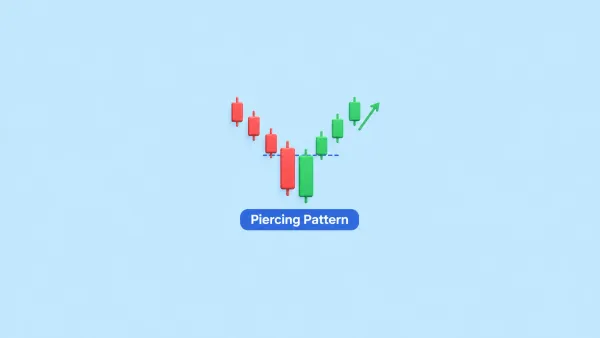
Understanding candlestick patterns can help traders study price movements and identify possible changes in market direction. One such pattern is the Piercing Pattern, which may signal a shift from selling pressure to buying pressure after a price decline. The pattern consists of two candles and is commonly used in technical analysis to identify a possible bullish reversal. However, it does not guarantee that prices will rise. Traders usually look for confirmation from the following candles, tr
14 October 2026
Made for Traders.
Trusted by Investors.
Download FinX — trade confidently, invest
smarter, track everything.

Table of Contents

- What is the Delta Neutral Strategy?
- What is the Delta Neutral Trading Strategy?
- How the Delta Neutral Strategy Works
- Key Concepts for Delta Neutral Trading
- Popular Delta Neutral Strategies
- Delta Hedging: The Engine Behind Neutrality
- Tools and Platforms for Delta Neutral Trading
- How to Trade Delta Neutral Strategies
- Limitations of the Delta Neutral Strategy
- What is the Taxation of Delta Neutral Trading in India?
- Conclusion
- FAQs