

Options trading has gained significant popularity among Indian investors as more people explore opportunities in the derivatives market. One of the most important concepts to understand is the at-the-money option, which refers to an option whose strike price is equal to or very close to the current market price of the underlying asset. These options are widely traded because they offer a balance between premium cost and price sensitivity.
For investors entering the world of futures and options trading, understanding what an at-the-money option is can help them select suitable strategies and manage risk effectively. This article explains the meaning of the money option, how ATM options work, how to identify them, and the advantages, risks, and common strategies associated with them.
What is At the Money Option?
An at-the-money option refers to an options contract whose strike price is equal to or very close to the current market price of the underlying asset. In simple terms, when the strike price and the market price are almost the same, the option is considered "at the money."
To understand what is at the money option, consider this: a stock currently trading at ₹1,500. If there is a call option and a put option with a strike price of ₹1,500, both contracts would be classified as ATM options because their strike price matches the market price.
The money option's meaning becomes clearer when compared with other option categories. Unlike in-the-money (ITM) options, ATM options do not possess significant intrinsic value. Similarly, unlike out-of-the-money (OTM) options, they are not far away from profitability.
Instead, ATM options sit at the point where the strike price and market value are nearly identical. Because of this unique position, ATM options often experience substantial changes in value when the underlying asset moves. This characteristic makes them attractive to traders who expect meaningful price movements within a short period.
At the Money Call Option Example
Understanding the money call option example can help investors grasp the concept more easily.
Suppose shares of a company are currently trading at ₹2,000. A trader believes that the stock may rise over the next few days due to positive market sentiment.
The trader purchases a call option with the following details:
- Current Stock Price: ₹2,000
- Strike Price: ₹2,000
- Premium Paid: ₹75
Since the strike price is exactly equal to the market price, this contract is an ATM call option.
Now assume the stock rises to ₹2,150 before expiry. As the stock moves above the strike price, the option gains value. The trader may either sell the option for a profit or choose another suitable exit strategy.
This at the money call option example demonstrates how ATM call options can benefit traders who correctly anticipate an upward movement in the underlying asset.
When investors ask what is at the money call option, the answer is simple: it is a call option whose strike price is equal or nearly equal to the current market price of the underlying asset.
How ATM Options Work
ATM options derive most of their value from the possibility of future price movements rather than existing intrinsic value. Since the strike price is almost equal to the market price, these contracts rely heavily on time value and volatility.
For example, if Nifty is trading at 25,000 and a trader buys a 25,000 call option, the option's future value will depend on whether Nifty rises above the strike price before expiration.
One important concept associated with ATM options is the at-the-money option delta. Delta measures how much an option's premium is expected to change for every one-point movement in the underlying asset.
Typically:
- ATM call option delta is around +0.50
- ATM put option delta is around -0.50
This means an ATM call option may gain approximately ₹0.50 for every ₹1 increase in the underlying asset, while an ATM put option may gain approximately ₹0.50 for every ₹1 decline.
The at-the-money option delta is particularly important because it indicates that ATM options respond significantly to market movements without being as expensive as deep ITM contracts.
This balanced sensitivity is one reason many traders prefer ATM strikes for short-term trading opportunities.
ATM options are also highly influenced by implied volatility and time decay. If the underlying asset remains stagnant, the premium may decline over time, even if the trader's market view eventually proves correct.
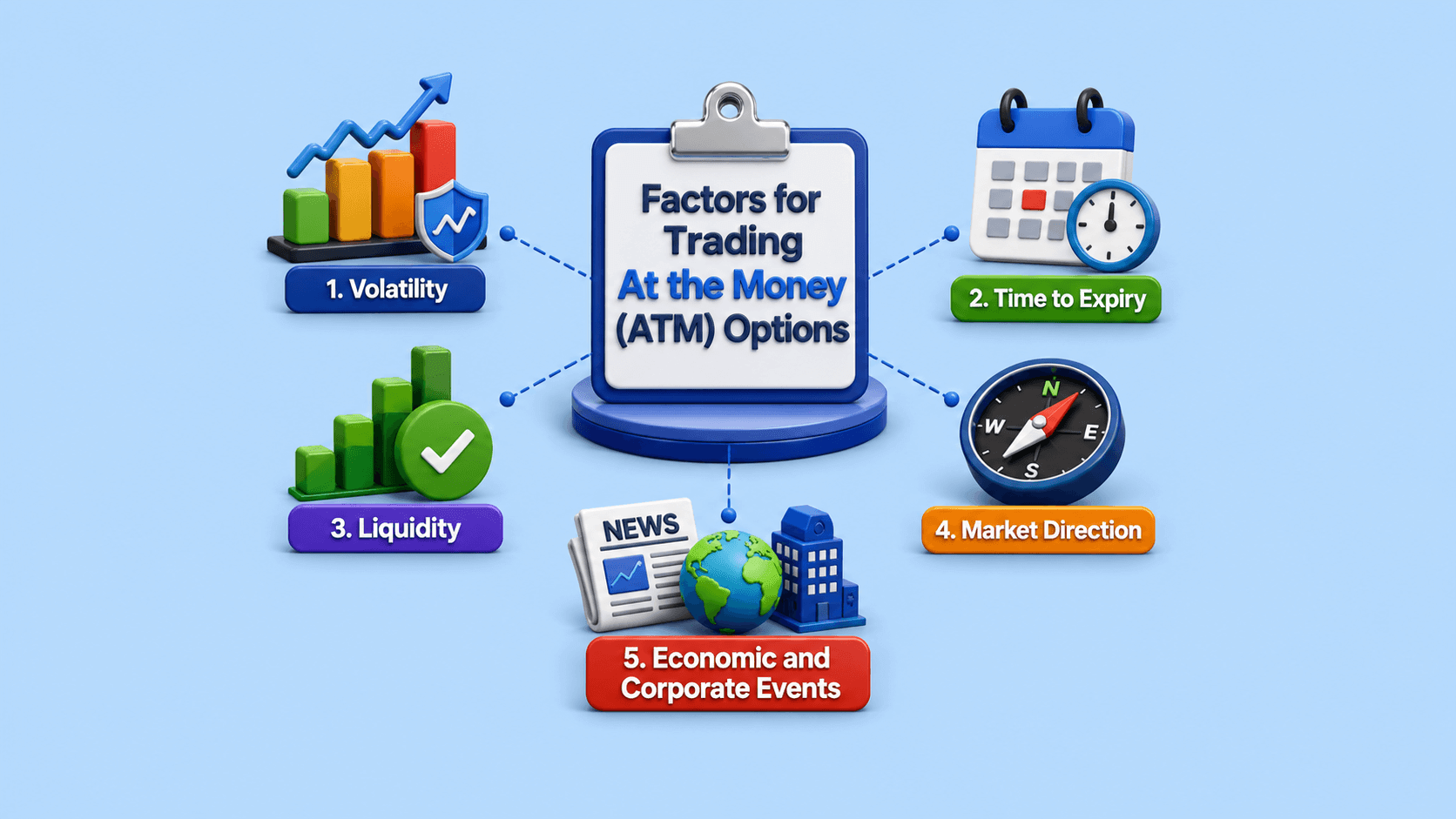
Factors for Trading At the Money (ATM) Options
Several factors can affect the performance of ATM options and should be considered before entering a trade.
Volatility
Volatility is one of the biggest drivers of option pricing. When volatility increases, ATM option premiums generally become more expensive because the probability of large price movements rises.
Time to Expiry
Time decay, also known as theta decay, can significantly affect ATM options. As expiry approaches, the option's time value gradually reduces. If the expected price movement does not occur quickly, the premium may decline.
Liquidity
ATM strikes often attract higher trading volumes than other strikes. Higher liquidity usually results in tighter bid-ask spreads and easier trade execution.
Market Direction
ATM options are frequently used when traders expect a strong directional move in either direction. A clear market outlook can improve the probability of successful trades.
Economic and Corporate Events
Events such as RBI policy announcements, quarterly earnings reports, inflation data, and Union Budget presentations can trigger sharp market movements and influence ATM option prices.
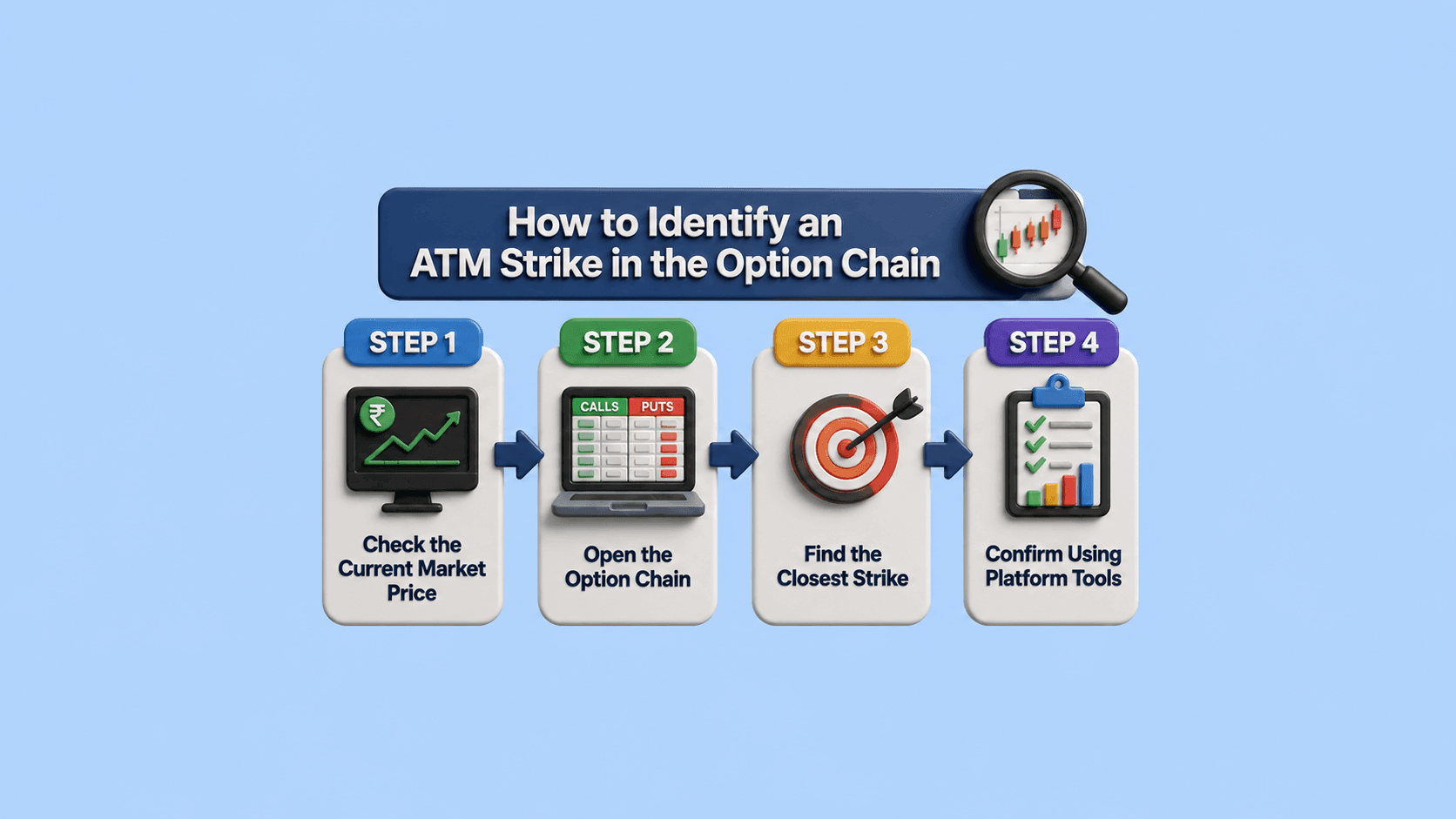
How to Identify An ATM Strike in the Option Chain
Identifying ATM strikes is a straightforward process once you understand how option chains work.
Step 1: Check the Current Market Price
First, determine the current market value of the stock or index.
For example:
- Nifty = 25,150
Step 2: Open the Option Chain
View the available strike prices on your trading platform.
Step 3: Find the Closest Strike
Locate the strike price nearest to the current market price.
For example:
- 25,100 Strike
- 25,150 Strike
- 25,200 Strike
The strike closest to Nifty's current level is considered the ATM strike.
Step 4: Confirm Using Platform Tools
Many broker platforms automatically highlight ATM contracts, making them easier to identify.
For investors from smaller cities who are still learning derivatives, this feature can simplify the process of selecting ATM options and understanding option chain data.
When to Trade ATM Options
ATM options may be suitable in various market situations.
Before Major Events
Many traders consider ATM options before events that can create substantial volatility, such as:
- RBI monetary policy announcements
- Corporate earnings releases
- Budget announcements
- Global economic data releases
During Strong Trend Expectations
If traders expect a significant upward or downward move, ATM options may provide effective exposure to that movement.
For Short-Term Trading
ATM options are commonly used in intraday and short-term trading because they react quickly to price changes.
For Strategy Building
Several popular options strategies use ATM strikes as their foundation because they provide balanced risk-reward characteristics.
ATM vs ITM vs OTM: Key Difference
Understanding the differences between ATM, ITM, and OTM options is essential for making informed trading decisions.
| Feature | ATM Option | ITM Option | OTM Option |
|---|---|---|---|
| Strike Price | Equal to or close to the market price | Favourable compared to the market price | Unfavourable compared to the market price |
| Intrinsic Value | Minimal or zero | Present | Zero |
| Premium Cost | Moderate | Higher | Lower |
| Delta | Around 0.50 | Higher than 0.50 | Lower than 0.50 |
| Time Decay Impact | High | Moderate | High |
| Liquidity | Usually High | Moderate | Varies |
ATM options often represent a middle ground between the higher cost of ITM options and the lower probability of profitability associated with OTM contracts.
Common ATM Strategies
Long ATM Call
Traders buy an ATM call option when they expect the underlying asset to rise significantly.
Long ATM Put
This strategy is used when traders anticipate a substantial decline in the market or a specific stock.
Long Straddle
A long straddle involves buying both an ATM call option and an ATM put option with the same strike price and expiry date.
This strategy is typically used when traders expect significant volatility but are unsure about the direction of the move.
Short Straddle
A short straddle involves selling both ATM call and ATM put options simultaneously.
While this strategy can generate income when markets remain stable, it carries significant risk and is generally used by experienced traders.
ATM Covered Call
Investors who already own shares may sell ATM call options against their holdings to earn premium income.
Advantages and Disadvantages
ATM options offer several benefits, but they also come with risks that traders should understand.
Advantages
- Generally offer high liquidity.
- Easier to identify in option chains.
- Provide balanced premium costs.
- React strongly to underlying price movements.
- Suitable for multiple trading strategies.
- Widely traded in stock and index derivatives.
Disadvantages
- Time decay can reduce premium value rapidly.
- Losses can occur if the expected move does not happen.
- Volatility changes can impact option pricing.
- Require active monitoring and disciplined risk management.
- Near-expiry ATM options can be highly volatile.
Conclusion
Understanding what is at the money option is important for anyone looking to trade options. Since ATM options have a strike price that is equal to or close to the current market price, they offer a balance between premium cost and sensitivity to market movements. This makes them a popular choice among traders.
Whether you are new to futures and Option trading or have prior market experience, knowing the at-the-money option meaning, how ATM options work, and the risks involved can help you make more informed trading decisions. With proper analysis and risk management, ATM options can be used effectively in a variety of trading strategies.
FAQs
What is an ATM option?
An ATM (At the Money) option is an options contract whose strike price is equal to or very close to the current market price of the underlying asset.
How to know if an option is ITM or OTM?
An option is ITM when it has intrinsic value based on the current market price. It is OTM when exercising the option would not result in intrinsic value.
How to identify an at-the-money option in trading?
Compare the current market price of the underlying asset with available strike prices in the option chain. The strike price closest to the market price is generally considered the ATM strike.
What is the risk of buying at-the-money options?
The primary risk is time decay. If the underlying asset does not move significantly before expiry, the option premium may decline, resulting in a loss for the buyer. Additionally, changes in volatility can also affect option prices.
Disclaimer: This article is for informational and educational purposes only and should not be considered investment or trading advice. Options trading involves significant risk, and investors should assess their financial goals and risk tolerance before making any investment decisions. Always consult a qualified financial advisor if needed.
Related Blog


The overall month has been quite unpredictable. While many on the chart stood strong, most of them have slipped. Bank Nifty on the other hand maintained its grip for a long time but now appears slightly bearish. Let’s see what the coming month holds for the investors as Mr. Sumeet Bagadia, Executive Director of Choice takes us through the weekly predictions of the market. Nifty Prediction For Next Week (24th August - 28th August 2026) The Nifty 50 witnessed a volatile week, with selling press
21 August 2026

Prism, the parent company of global travel-tech unicorn OYO, has moved closer to its proposed stock market debut after receiving clearance from the Securities and Exchange Board of India (SEBI), filing its Updated Draft Red Herring Prospectus (UDRHP), and beginning its roadshow for a proposed ₹6,650 crore initial public offering (IPO). The company, which is led by Ritesh Agarwal, has started meeting institutional investors as it prepares for its public-market debut later this year. The proposed
21 August 2026

FII DII Data Today 21th August 2026 CATEGORY DATE BUY VALUE (₹ Crores) SELL VALUE (₹ Crores) NET VALUE (₹ Crores) DII 21-Aug-2026 13,209.23 11,599.76 1,609.47 FII 21-Aug-2026 11,634.11 11,769.68 -135.57 What are FII and DII in the Stock Market Foreign Institutional Investors (FIIs) invest in the Indian stock market from international markets, while Domestic Institutional Investors (DIIs) include mutual funds and institutional bodies operating from India. fii dii data helps track
20 August 2026
Made for Traders.
Trusted by Investors.
Download FinX — trade confidently, invest
smarter, track everything.
Table of Contents
