August 12, 2026
What is Client ID in Demat Account
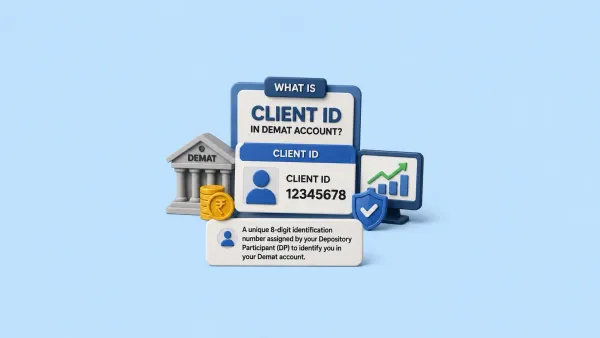
Client ID is a unique identification number assigned to an investor’s Demat account by the Depository Participant (DP). Know What is Client Id in detail in this blog.

 ₹0 Account Opening Charges
 Dedicated Relationship Manager
 Enjoy Tax Benefits*
Start investing as a Hindu Undivided Family in just 4 steps
STEP 1
Enter Karta’s mobile, complete OTP, upload HUF PAN, HUF deed, and HUF address proof
STEP 2
Submit Karta’s PAN and signature; complete online In-Person Verification
STEP 3
Provide Karta’s personal/address proof and list HUF members/coparceners
STEP 4
Upload HUF bank proof, complete bank verification, and enable trading/investment segments

Specialised assistance for HUF-specific queries, documentation, and account management.

Web & mobile platforms with real-time market data, charting tools, and seamless order execution.

Access research‑backed insights and reports by our expert analysts for data‑driven investment decisions.

Invest in equity, derivatives, commodities, and mutual funds, all from a single HUF account.

Optimize your family’s tax liability with HUF status while building wealth through strategic investments.

Partner with SEBI-registered broker with over three decades of experience serving Indian investors.
Ideal for families who want to manage wealth collectively while enjoying tax advantages

Consolidate inherited assets under a single entity for easier tracking and succession planning.

Use the separate tax status of HUF to optimise family tax liability and create an additional income slab.

Pool resources from multiple members to make larger, more strategic investments across asset classes.

Ensure smooth transfer of investments to the next generation with continuity under the HUF structure.

Invest and trade with low DP and brokerage charges.

₹0 AMC for First Year
₹0 Auto Square-off Charges
₹0 Call & Trade Fee
Check if your family qualifies to open an HUF account
 Must be a Hindu Undivided Family as per Hindu law, including Jains, Sikhs, and BuddhistsHUF must have a valid PAN card issued by the Income Tax DepartmentKarta must be 18 years or above (eldest coparcener; daughters can also become Karta if they are the senior-most coparcener)HUF deed / Declaration must be properly drafted and registeredBank account in the name of HUF is mandatory(Individual bank accounts of family members cannot be linked to the HUF Demat account)
Learn how a HUF Demat account adds value to your family's wealth-building journey

A HUF demat account is a dematerialized account opened in the name of a Hindu Undivided Family, allowing the family unit to hold and trade securities in electronic form. Unlike individual demat accounts, an HUF account enables collective family investments under a single entity, providing tax advantages and simplified wealth management for Hindu families, including Jains, Sikhs, and Buddhists.
The account is operated by the Karta (head of the family), who manages investments on behalf of all coparceners (family members). This structure allows families to pool resources, invest collectively, and potentially reduce their overall tax burden while maintaining clear ownership of assets.
An HUF demat account functions similarly to an individual demat account but operates under the HUF entity. The Karta, as the head of the family, has the authority to make investment decisions, execute trades, and manage the portfolio. However, the assets belong to the HUF as a whole, not to any individual member.
When you open a HUF demat account online, you need to submit the HUF PAN card, HUF deed, and the Karta's identification documents. Once the account is active, you can buy and sell shares, invest in mutual funds, trade in derivatives, and hold other securities. All transactions are recorded in the name of the HUF, and any income generated is taxed as per HUF income tax rules.
Before you proceed with HUF demat account opening, understanding a few key aspects can help ensure a smooth process and effective management of your family's investments.
Separate PAN Required: The HUF must have its own PAN card, which is different from the individual PAN cards of family members. This is mandatory for opening any HUF account.
Karta's Role: The Karta manages all investment decisions and account operations. In case of the Karta's demise, the next senior male member typically becomes the new Karta.
Tax Implications: HUF is taxed as a separate entity. Income from investments is taxed under HUF income tax slabs, which can offer tax advantages when planned properly.
Bank Account : A bank account in the name of the HUF is essential for fund transfers and withdrawals. Individual bank accounts cannot be linked to an HUF demat account.
Documentation: Keep all HUF demat account documents ready, including the HUF deed, HUF PAN, bank proof, and the Karta's identity proofs for a faster account opening process.
Trading through an HUF demat account is similar to trading through an individual account, but with the HUF as the account holder. The Karta can place buy and sell orders for equity shares, derivatives, commodities, currencies, and other permitted securities through the broker's trading platform.
To begin trading, the Karta logs into the trading platform using the HUF account credentials. Funds must be transferred from the HUF's linked bank account to the trading account. All trades are executed in the HUF's name, and profits or losses belong to the HUF entity. Contract notes, statements, and tax documents are generated in the HUF's name, making it easier to maintain records for income tax filing.
Yes, can HUF invest in mutual funds is a common question, and the answer is affirmative. HUFs are permitted to invest in mutual funds, just like individual investors. The HUF can invest in equity mutual funds, debt funds, hybrid funds, and other schemes offered by various asset management companies.
To invest in mutual funds, the HUF must complete the KYC process with a SEBI-registered intermediary. The investments are made in the HUF's name using the HUF PAN card. Returns from mutual funds, including dividends and capital gains, are taxed as per HUF income tax regulations. This allows families to diversify their portfolio and benefit from professional fund management while maintaining the tax advantages of an HUF structure.
An HUF consists of coparceners who have a birthright in the family property. Traditionally, only male descendants up to four generations could be coparceners. However, following amendments to the Hindu Succession laws, daughters now have equal coparcenary rights in the HUF property.
Members of an HUF include:
New members are typically added by birth or marriage into the family. When you open HUF account online, you need to list all current coparceners in the HUF deed.
Opening a demat account for HUF offers several benefits for families looking to optimize their wealth management and tax planning:
Members of an HUF include:
Understanding the distinction between an HUF demat account and a regular individual demat account helps families make informed decisions about their investment structure:
Stay updated with the latest stock market news and articles.
Championing the rights of individuals and businesses to financial freedom.
Families across India share their HUF Demat Account journey with Choice