
The Multi-Commodity Exchange of India (MCX) is India’s largest commodity derivatives exchange, and many beginners often ask what MCX is and how it works. MCX allows traders to buy and sell futures contracts in commodities like gold, silver, crude oil, natural gas, and agricultural products. To participate, investors typically need to open a commodity trading account with a registered broker. Established in 2003 and regulated by SEBI, MCX provides a transparent platform for price discovery and risk management.
This guide explains what MCX is, how commodity trading works, and why it is an important diversification tool for Indian investors.
What Is MCX Trading?
The Multi-Commodity Exchange of India (MCX) is one of the largest commodity derivatives exchanges in India. It allows traders and investors to buy and sell commodity futures contracts such as gold, silver, crude oil, natural gas, copper, and agricultural commodities.
The MCX market is a platform where commodities are traded in the form of derivatives, particularly futures contracts. These contracts allow traders to speculate on the future price movements of commodities without physically owning them.
Many investors also ask what MCX is in the share market or what MCX is in the stock market. While MCX operates similarly to stock exchanges like NSE and BSE, the key difference is that it deals with commodities instead of company shares.
The exchange was established in 2003 and is regulated by the Securities and Exchange Board of India (SEBI). It provides a transparent and structured marketplace for commodity trading, ensuring price discovery and risk management for participants.
Today, MCX is widely used by traders, hedgers, and investors who want exposure to commodity price movements.
How Does MCX Work?
Understanding how MCX works is essential before entering commodity trading. MCX functions as an electronic platform where buyers and sellers trade commodity futures contracts.
A futures contract is an agreement to buy or sell a commodity at a predetermined price on a future date. Instead of trading the actual commodity, traders speculate on price movements.
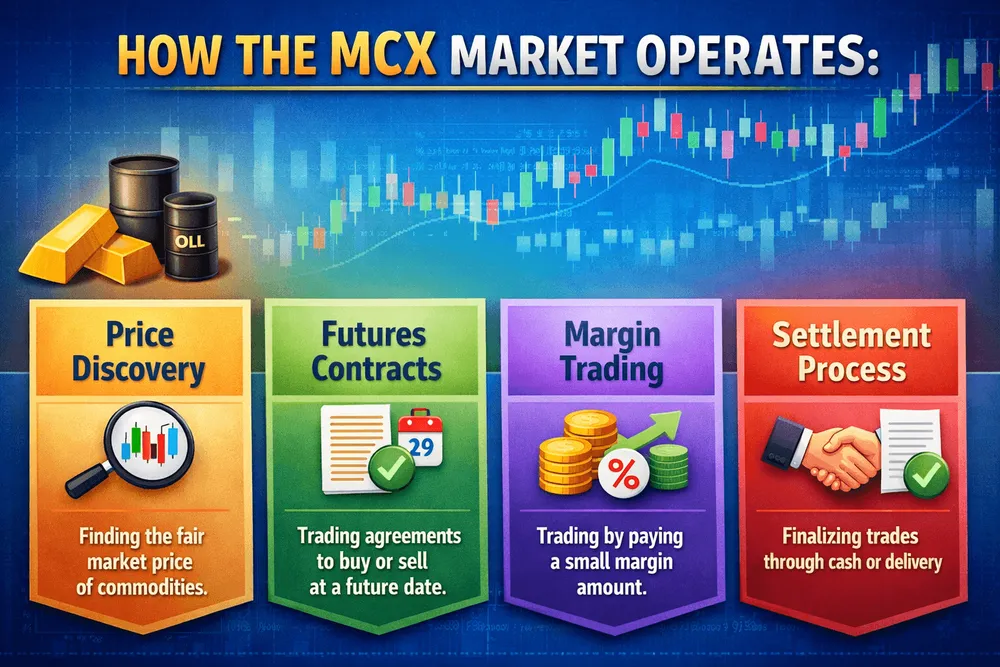
Here is how the MCX market operates:
1. Price Discovery
Prices on MCX are determined through demand and supply dynamics. Global commodity prices, geopolitical events, economic data, and currency fluctuations influence commodity prices.
2. Futures Contracts
Most traders on MCX happen through futures contracts. For example, a trader may buy a gold futures contract expecting the price to rise.
3. Margin Trading
Unlike stock trading, MCX allows traders to take positions by paying a margin amount, which is a fraction of the total contract value.
4. Settlement Process
Contracts are either settled before expiry or through final settlement on the expiry date. Most traders close their positions before the contract expires.
This system enables traders to profit from both rising and falling commodity prices.
Check Margin in Commodity - Commodity Margin Calculator
Commodities You Can Trade On MCX
One of the reasons why the MCX market is popular among traders is the wide variety of commodities available for trading.
Below are the major categories of MCX commodities:
1. Precious Metals
These are among the most actively traded commodities.
- Gold
- Silver
- Gold Mini
- Gold Guinea
2. Base Metals
Industrial metals are widely used in manufacturing.
- Copper
- Aluminium
- Zinc
- Lead
- Nickel
3. Energy Commodities
Energy products are influenced by global demand and geographical developments.
- Crude Oil
- Natural Gas
4. Agricultural Commodities
Some agricultural commodities are also traded on MCX.
- Cotton
- Mentha Oil
Each commodity has its own contract specifications, such as lot size, expiry date, and margin requirement.
Essential Features of Commodity Trading On MCX
Commodity trading on MCX offers several unique features that differentiate it from traditional stock market trading.
1. Extended Trading Hours
Many traders ask what the MCX trading time is. MCX offers longer trading hours compared to equity markets.
Typical MCX trading time is:
- Morning Session: 9:00 AM - 5:00 PM
- Evening Session: 5:00 PM - 11:30 PM / 11:55 PM (depending on daylight savings in international markets)
Extended hours allow traders to react to global commodity price movements.
2. High Liquidity
MCX provides high liquidity in popular commodities such as gold and crude oil, making it easier for traders to enter and exit positions.
3. Leverage through Margin
Traders can take larger positions by depositing a margin amount rather than paying the full contract value.
4. Transparent Price Discovery
All transactions occur electronically, ensuring transparent and fair price discovery.
5. Risk Management Tools
MCX offers hedging opportunities for businesses that rely on commodities.
Why Trade On MCX?
Commodity trading offers several advantages for investors looking to diversify beyond stocks and mutual funds.
Here are some key reasons why traders participate in the MCX market:
➔ Portfolio Diversification
Commodities often behave differently from equities. Investing in commodities can help reduce overall portfolio risk.
➔ Hedge Against Inflation
Precious metals like gold and silver often act as a hedge against inflation and economic uncertainty.
➔ Global Market Opportunities
Commodity prices are influenced by international factors, giving traders exposure to global market movements.
➔ Opportunity to Trade Both Sides
Traders can profit from both rising and falling prices by taking long or short positions.
➔ High Liquidity
Popular commodities like gold and crude oil have strong liquidity, which ensures smooth trade execution.
How to Trade On MCX?
To trade commodities, investors need a trading account with a brokerage platform that supports MCX trading and provides access to the commodity market.
Here is how to trade on MCX:
Step 1: Open a Trading and Demat Account
Register with a broker and complete the KYC verification process.
Step 2: Activate Commodity Segment
Ensure that the MCX commodity trading segment is activated in your account.
Step 3: Deposit Margin Funds
Add funds to your trading account to meet the margin requirements for commodity trades.
Step 4: Select the Commodity Contract
Choose the commodity you want to trade, such as gold or crude oil.
Step 5: Place the Trade
Select whether you want to buy or sell the futures contract based on your market view.
Step 6: Monitor and Exit
Track price movements and close the position before expiry if required.
How to Open an MCX Trading Account
Opening an MCX trading account is a straightforward process.
Documents Required
You typically need the following documents:
- PAN Card
- Aadhar Card
- Bank account details
- Address proof
- Passport-size photograph
Steps to Open an Account
1. Choose a SEBI-registered broker.
2. Fill out the online application form.
3. Complete KYC verification.
4. Activate the commodity trading segment.
5. Start trading on MCX.
Once your account is activated, you can begin trading commodities through the broker’s trading platform.
Conclusion
Understanding what MCX is opens doors beyond the traditional stock market. Whether you're hedging against inflation with gold or capitalizing on crude oil swings, the MCX market offers a regulated, transparent platform for diversification.
However, what is MCX trading at its core? It is a high-leverage activity. While the extended MCX trading time and global price movements offer significant profit potential, they also carry high risks. Success on the MCX requires discipline, continuous learning, and a reliable partner like Choice to help you navigate the volatility.
FAQs
What Is the Full Form of MCX?
MCX stands for Multi-Commodity Exchange.
Is MCX Regulated by SEBI?
Yes, MCX is regulated by the Securities and Exchange Board of India (SEBI).
What Time Does MCX Trading Take Place?
MCX trading runs from 9:00 AM to 11:30/11:55 PM (Monday–Friday).
What Is the Difference Between MCX and NSE?
National Stock Exchange of India Ltd (NSE) mainly deals in equities, equity derivatives, and other financial instruments, while MCX focuses primarily on commodity derivatives like gold, crude oil, and metals.
Can I Trade On MCX With Choice?
Yes, you can trade on MCX through Choice Broking after activating the commodity segment.
Disclaimer: This article is for educational and informational purposes only and should not be considered financial or investment advice. Commodity trading involves risk, and investors should consult a qualified financial advisor before making trading decisions.
Related Blog


Natural Gas Price Prediction for Next Week (19th October - 23th October 2026) Support 2 Support 1 CMP Resistance 1 Resistance 2 274 285 298.50 307 319 NYMEX Natural gas prices fell over 3% on Friday to $3.11/MMBtu, their lowest in more than a week, and lost around 3% for the week. Milder-than-normal weather through October 29 is expected to limit heating and cooling demand, pressuring prices. EIA storage rose 67 bcf, below forecasts and the five-year average of 90 bcf despite Middle
16 October 2026
Crude Oil Price Forecast for Next Week (19th October- 23th October 2026) Support 2 Support 1 CMP Resistance 1 Resistance 2 8800 9140 9573 9620 9920 WTI Crude oil prices surged above $100 per barrel, gaining over 11% for the week amid tightening global supply and strong shipping-sector fuel demand. Iranian strikes on tankers in the Strait of Hormuz disrupted oil flows, with average daily shipments falling to 11.62 million barrels in the week to October 13, against a baseline of 17.15
16 October 2026
Copper Price Forecast for Next Week (19th October- 23th October 2026) Support 2 Support 1 CMP Resistance 1 Resistance 2 1370 1389.30 1402.30 1432.20 1450 LME Copper prices declined 1.33% over the week as US dollar strength, interest-rate hike concerns and fears of a slowdown in Al-related capital expenditure weighed on market sentiment. The International Copper Study Group forecasts refined copper surpluses of 96,000 tonnes in 2026 and 377,000 tonnes in 2027, while China's smelting c
16 October 2026
Made for Traders.
Trusted by Investors.
Download FinX — trade confidently, invest
smarter, track everything.