
In the fast-paced world of intraday trading, timing and price precision are the difference between a winning trade and a missed opportunity. Traders often rely on technical indicators to identify entry and exit points, but few carry as much weight as the VWAP trading strategy.
Before you start clicking "buy" or "sell," you must clearly understand what VWAP in trading is, how it works, and how to use it effectively in real market conditions. In this guide, we will explore the complete concept, including its calculation, strategies, and limitations.
What Is VWAP In Trading Strategy?
The VWAP full form is "Volume Weighted Average Price". The meaning of VWAP in stock market terms is quite logical: it represents the average price of a stock throughout the trading day, weighted by the volume of shares traded at each price level.
VWAP in stock market trading is a cumulative intraday indicator that provides the "true" average price.
Unlike a simple moving average, it doesn't just look at the clock; it looks at the money.
- Price above VWAP: Indicates bullish sentiment (buyers are in control).
- Price below VWAP: Indicates bearish sentiment (sellers are in control).
How To Calculate VWAP?
Understanding the VWAP calculation is vital if you want to trust the signals it generates. Unlike indicators that lag behind, VWAP builds its data from the very first candle of the day. The following is the formula for VWAP:
VWAP = ∑(Price × Volume) / ∑ Volume
The top part of the VWAP formula represents the combined value of all trades during a selected time frame (price multiplied by volume), while the bottom part represents the total volume traded during that same period. In simple terms, it shows the average price of a stock after considering the quantity traded at each level.
On a price chart, the VWAP indicator appears as a single line that moves along with the stock price throughout the trading session. If the price stays above the VWAP line, it generally suggests that the stock is trading at a premium compared to its average price for the day. On the other hand, when the price falls below the VWAP line, it indicates that the stock is trading at a discount relative to its average.
Now, let’s talk about Anchored VWAP.
The calculation formula remains the same:
Anchored VWAP = ∑ (Price × Volume) / ∑ Volume
However, what makes it different is the starting point. Instead of beginning from the market open like the regular VWAP, Anchored VWAP allows traders to select a specific date or event as the starting point. For example, a trader might anchor it to a major news announcement, earnings release, breakout level, or any significant market event.
This flexibility helps traders analyze price behavior from a meaningful reference point, making Anchored VWAP especially useful for identifying trend strength, support, and resistance after important market events.
VWAP Strategy Explained
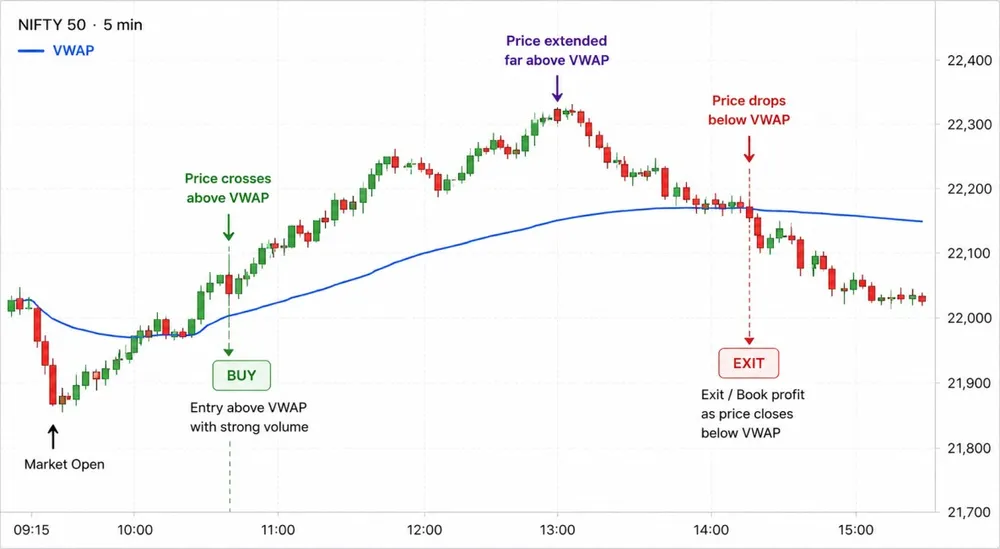
Now, let's look at what VWAP trading is in a practical, real-world sense. The core of any VWAP trading strategy is the interaction between the current price and the VWAP line.
- The Buy Signal: When the price breaks and sustains above the VWAP line with high volume, it suggests strong institutional buying.
- The Sell Signal: If the price drops below the line and fails to recover, it signals weakness and a potential short-selling opportunity.
- Dynamic Support & Resistance: In a trending market, the VWAP line often acts as a floor during pullbacks or a ceiling during rallies.
Types of VWAP Strategies
There isn’t just one single best VWAP strategy. Instead, traders adapt it to their style.
1. VWAP pullback strategy
Traders wait for the price to trend above VWAP and then pull back toward it before entering long positions.
2. VWAP breakout strategy
When the price breaks above or below VWAP with strong volume, traders enter the breakout direction.
3. VWAP reversal strategy
If the price deviates too far from VWAP, mean reversion traders expect it to return toward VWAP.
4. Multi-Timeframe VWAP strategy
Some traders use daily VWAP along with weekly or anchored VWAP for better context.
Each approach depends on market conditions, volatility, and your risk appetite.
Advantages & Disadvantages of VWAP Strategy
| Advantages of VWAP Strategy | Disadvantages of VWAP Strategy |
|---|---|
| Institutional Benchmark: Used by hedge funds and institutions. | Intraday Limitation: Standard VWAP resets daily. |
| Volume-Based Accuracy: Incorporates trading activity, not just price. | Lagging Nature: Based on historical data. |
| Clear Trend Bias: Helps identify bullish or bearish intraday bias. | Not Ideal for Long-Term Investing: Better suited for short-term trading. |
| Dynamic Support/Resistance: Acts as a real-time reference level. | False Signals in Low Volume Markets: Volume irregularities can distort VWAP. |
| Reduces Emotional Trading: Provides structure to entries and exits. |
How to Implement the VWAP Strategy
If you’re wondering how to use the VWAP indicator, follow this practical framework:
1. Open your trading platform.
2. Add the VWAP indicator to your intraday chart.
3. Observe whether the price is above or below VWAP.
4. Wait for pullbacks or confirmations.
5. Use stop-loss below VWAP for long trades and above VWAP for short trades.
6. Combine with volume analysis for stronger signals.
Risk management remains essential. Even the best VWAP strategy fails without discipline.
Example of VWAP Strategy
Example 1: Bullish Intraday Trend
A stock opens strong and stays above VWAP. It pulls back slightly toward VWAP but does not break below it. A trader enters long near VWAP and rides the trend upward.
Example 2: Bearish Breakdown
Price opens above VWAP but quickly falls below with strong selling volume. Trader enters short below VWAP and exits when price consolidates.
These examples show how the meaning of VWAP in stock market trading translates into actionable decisions.
Conclusion
To summarise, what is VWAP in stock market trading? It is the heartbeat of intraday price action. By mastering the meaning of VWAP in stock market contexts and understanding the nuances of VWAP calculation, you gain a significant edge over retail traders who only look at price.
While the VWAP trading strategy is powerful, remember it works best when combined with price action and disciplined risk management.
FAQs
What Is the Best VWAP Strategy?
The best VWAP trading strategy is usually the pullback strategy in a strong trend, combined with volume confirmation and proper stop-loss.
Can the VWAP Strategy Be Used for Long-Term Trading?
No, VWAP is primarily an intraday indicator because it resets daily. For long-term trading, moving averages are more suitable.
What Is VWAP, and How Is It Different From a Simple Moving Average?
VWAP includes volume in its calculation, while a simple moving average considers only price. This makes VWAP more accurate for intraday analysis.
What Is the Best VWAP Strategy?
A combination of VWAP breakout with volume confirmation and RSI filtering is considered effective by many traders.
Can VWAP Be Combined With Other Indicators?
Yes. VWAP works well with RSI, MACD, moving averages, and price action strategies for better trade confirmation.
Disclaimer: This article is for educational purposes only and does not constitute financial or investment advice. Trading involves risk, and you should consult a qualified financial advisor before making investment decisions.
Related Blog


Nifty Prediction For Tomorrow The Nifty 50 tomorrow market prediction indicates a Sideways trend. The range is between 22250 and 22700, with support at 22250-22400 and resistance at 22650-22700. Traders should monitor these crucial levels closely for potential market shifts. Nifty 50 Share Price * Nifty Support: 22250-22400 * Nifty Resistance: 22650-22700 * BIAS: Sideways 20-Day EMA 50-Day EMA 100-Day EMA 200-Day EMA 23072.31 23518.70 23803.70 24111.80 Nifty Range 22250
10 October 2026

Natural Gas Price Prediction for Next Week (12th October - 16th October 2026) Support 2 Support 1 CMP Resistance 1 Resistance 2 285.30 302 313.70 318.80 330 NYMEX Natural gas prices rallied 7%, driven by heightened supply fears as escalating Iranian attacks on commercial vessels in the Strait of Hormuz threatened global energy transit. Additional upward momentum stemmed from Category 3 Hurricane Isaias threatening the US Gulf Coast, though price impacts tempered after it weakened to
10 October 2026

Crude Oil Price Forecast for Next Week (12th October- 16th October 2026) Support 2 Support 1 CMP Resistance 1 Resistance 2 8200 8550 8890 9054 9500 WTI Crude prices wavered near $91.50 per barrel on Friday, ultimately capping a slight 0.2% weekly gain as conflicting geopolitical and weather-driven catalysts collided. Upward momentum was fueled by severe domestic supply disruptions from Hurricane Isaias, which forced Gulf of Mexico producers to shut in up to 72% of regional crude outp
10 October 2026
Made for Traders.
Trusted by Investors.
Download FinX — trade confidently, invest
smarter, track everything.