

What if you could trade market volatility without guessing whether prices will rise or fall? That is exactly where the straddle option strategy in the futures and options (F&O) segment comes into play. Widely used in the Indian derivatives market, this strategy enables traders to benefit from sharp price movements or stable market conditions, depending on the strategy's structure.
In this blog, you will learn the straddle meaning, how the strategy works, step-by-step execution, differences between long and short straddles, and how to decide which straddle strategy suits you best.
What Is A Straddle Option Strategy?
A straddle option strategy involves taking positions in both a call option and a put option on the same underlying asset, with:
- The same strike price
- The same expiry date
The strike price chosen is almost always At-The-Money (ATM), the strike price closest to the current market price (spot price) at the time of execution. For beginners, it is crucial to remember that as the market fluctuates, the "ATM" strike changes; you must select the strike based on where the market is trading at the exact moment you enter the trade.
In simple terms, a straddle is a direction-neutral strategy. Instead of betting on whether the market will go "Up" or "Down," you are betting on volatility.
- If you expect a massive move (but aren't sure which way), you "Long" the straddle by buying both options.
- If you expect the market to stay flat (sideways), you "Short" the straddle by selling both options.
How Does the Straddle Strategy in Options Trading Work?
The straddle option strategy shifts a trader’s focus from predicting price direction to assessing price movement. Instead of asking whether the market will go up or down, the key question becomes: Will the market move enough to justify the cost or risk of the position?
The mechanics of a straddle depend entirely on your volatility outlook and whether you are buying or selling options.
1. Long Straddle Strategy:
Market View: You expect a significant price movement, but the direction is uncertain. This scenario is common ahead of major events such as the Union Budget, RBI policy announcements, or quarterly earnings.
How It Works: In a long straddle, you buy both a call option and a put option at the same strike price and expiry. If the market moves sharply upward, the call option increases rapidly in value, while the put option loses value, limited to the premium paid. If the market moves sharply downward, the opposite occurs.
Because gains on the profitable option can be substantial, they can outweigh the loss on the losing option, resulting in a net profit if the move is large enough.
Key Trade-off: Since you are paying premiums for two options, the market must move beyond the breakeven points for the strategy to become profitable. If the price remains range-bound, time decay gradually erodes the option value, leading to a loss.
2. Short Straddle Strategy:
Market View: You expect the market to remain range-bound with declining volatility, typically during periods of consolidation or after major events.
How It Works: In a short straddle, you sell both the call and the put option at the same strike price and expiry. By doing so, you collect premiums upfront. If the market stays within a narrow range, both options lose value over time due to time decay (Theta). On expiry, if the price remains close to the strike, both options may expire worthless, allowing you to retain the entire premium as profit.
Key Trade-off: While this strategy benefits from stable markets, it carries high risk. A sharp move in either direction can lead to significant losses, unlimited on the upside and substantial on the downside. As a result, short straddles require strict risk management, sufficient margin, and are generally more suitable for experienced traders.
Step-by-Step Process for Building A Straddle Position
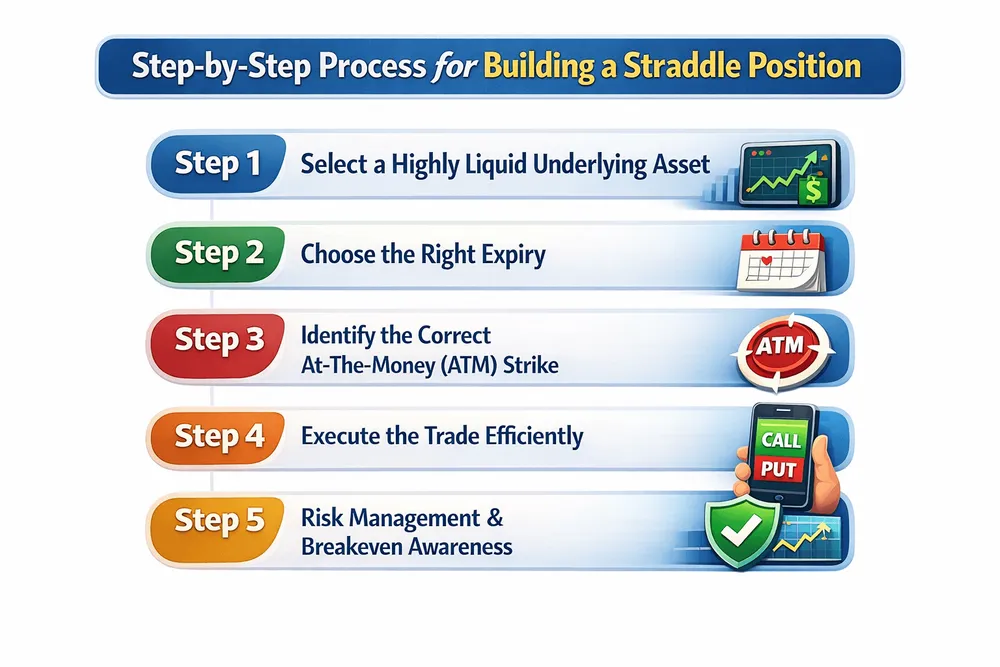
Executing a straddle option strategy is as important as understanding it. Many beginners lose money due to poor execution, low liquidity, or ignoring breakeven levels. The steps below help avoid these common mistakes.
Step 1: Select a Highly Liquid Underlying Asset
Liquidity should be your first filter. In the Indian market, Nifty 50 and Bank Nifty are preferred for straddle strategies because they offer:
- High trading volume
- Narrow bid-ask spreads (lower entry and exit cost)
- Reliable option pricing
A narrow bid-ask spread is crucial, especially for straddles, because you are trading two options simultaneously. Wider spreads can significantly reduce profitability.
Step 2: Choose the Right Expiry
Your expiry selection should align with your trading objective.
- Weekly Expiry: Best suited for short-term, high-impact events such as RBI policy decisions, inflation data, or Budget announcements. These trades rely on quick volatility expansion.
- Monthly Expiry: More suitable for stock-specific straddles or when you expect a large move to develop over time. Monthly options provide more time value but cost more.
Step 3: Identify the Correct At-The-Money (ATM) Strike
The ATM strike is the strike price closest to the current spot price at the time of execution.
Example: If Nifty is trading at 19,512, the ATM strike is 19,500.
Choosing the ATM strike is important because:
- It offers the highest Gamma, meaning the option responds faster to price changes
- This sensitivity is what makes the straddle strategy effective during sharp moves
Remember, the ATM is not fixed; it changes as the market moves. Always select the ATM strike based on the spot price at execution, not earlier.
Step 4: Execute the Trade Efficiently
- For a Long Straddle Strategy: Buy the ATM call and ATM put simultaneously. Many Indian brokers offer basket or combo orders, which help avoid execution delays and price slippage.
- For a Short Straddle Strategy: Sell the ATM call and ATM put together. Before placing the trade, ensure you have sufficient margin, typically ₹1.5 lakh to ₹2 lakh per lot for Nifty, depending on volatility and broker policies.
Simultaneous execution is critical. Entering one leg late can distort risk and breakeven levels.
Step 5: Risk Management & Breakeven Awareness
Before clicking “Confirm,” always calculate your breakeven points. These levels define where your trade transitions from loss to profit.
Knowing your breakevens helps you:
- Set realistic expectations
- Avoid emotional decision-making
- Identify when the trade is unlikely to work
Practical Thumb Rule: A Nifty long straddle typically requires a move of approximately 1.5% to 2% before expiry to become meaningfully profitable. If the market is not showing signs of such movement, it may be wise to exit early.
Long Straddle vs Short Straddle Option Strategy
Both long and short straddle strategies use the same structure, call and put options at the same strike and expiry, but differ significantly in market outlook, risk, and execution.
| Parameter | Long Straddle Option Strategy | Short Straddle Option Strategy |
|---|---|---|
| Market Outlook | High volatility expected; direction uncertain | Low volatility expected; range-bound market |
| Trader’s Role | Option buyer | Option seller (writer) |
| Primary Objective | Profit from a sharp move in either direction | Earn premium through time decay |
| When It Works Best | Before major events (Budget, RBI policy, earnings) | After events or during consolidation phases |
| Entry Setup | Buy ATM Call + Buy ATM Put | Sell ATM Call + Sell ATM Put |
| Capital Requirement | Limited to the total premium paid | High margin required |
| Typical Margin (Nifty)* | ₹12,000 - ₹15,000 per lot (premium only) | ₹1.5 - ₹2 lakh per lot (varies by volatility & broker) |
| Risk Profile | Limited risk | High risk (unlimited on upside, significant on downside) |
| Profit Potential | Unlimited in both directions | Limited to the total premium received |
| Time Decay (Theta) | Negative (works against you) | Positive (works in your favour) |
| Volatility (Vega) Impact | Benefits from rising volatility | Benefits from falling volatility |
| Breakeven Requirement | Price must cross the upper or lower breakeven point | Price must stay within the breakeven range |
| Probability of Small Gains | Lower | Higher |
| Stress Level | Moderate | High |
| Suitable For | Beginners and event-based traders | Experienced traders with strict risk control |
| Common Mistake | Entering too early and losing to time decay | Ignoring sudden volatility expansion |
*Margins are indicative and vary based on broker policies, volatility, and regulatory requirements.
Straddle Option Strategy Example
Assume Nifty is trading at 19,500.
- Buy 19,500 Call Option at ₹120
- Buy 19,500 Put Option at ₹130
Total Premium Paid = ₹250
Breakeven Points
A long straddle strategy has two breakeven levels:
Upper Breakeven = Strike Price + Total Premium
19,500 + 250 = 19,750
Lower Breakeven = Strike Price − Total Premium
19,500 − 250 = 19,250
This means Nifty must move more than 250 points, or approximately 1.28% (250 ÷ 19,500), in either direction for the trade to become profitable.
Understanding Greeks in a Straddle Strategy
In the Indian market, many traders get the direction right but still lose money because they ignore the Greeks. Here is how they impact your straddle:
1. Delta:
- Near zero at entry (direction-neutral)
- Turns positive or negative as the price moves
2. Theta (Time Decay):
- Long Straddle: Time is your enemy. Every day without movement reduces option value.
- Short Straddle: Time is your friend. Premium erodes in your favour.
3. Vega (Volatility Sensitivity):
- Long straddles benefit from rising volatility.
- Short straddles benefit from falling volatility.
The IV Crush Risk (Critical Warning)
After major events, such as the Union Budget or election results, Implied Volatility (IV) often drops sharply. This phenomenon, known as IV Crush, can hurt a long straddle even if the market moves slightly in your direction, because option premiums collapse.
This is why long straddles work best when the price move is strong and decisive.
Straddle vs Strangle: Quick Comparison
Understanding the difference between straddle and strangle helps traders choose the right volatility strategy.
| Feature | Straddle (ATM) | Strangle (OTM) |
|---|---|---|
| Strike Prices | Same (e.g., 19,500 CE & 19,500 PE) | Different (e.g., 19,700 CE & 19,300 PE) |
| Cost of Entry | High (Two ATM premiums) | Low (Two OTM premiums) |
| Sensitivity (Delta) | High (Starts moving immediately) | Low (Needs a "trigger" move first) |
| Breakeven | Closer to the current price | Further away from the current price |
| Risk of Total Loss | Lower (One side usually holds value) | Higher (Both can expire worthless easily) |
- Why Choose a Straddle? Use this when you are certain a move is coming, and you want to start profiting the moment the market moves even 0.5%. It is the "Premium" choice for precision trading.
- Why Choose a Strangle? Use this when you expect a massive, violent move (like a 3-4% gap) but want to risk very little capital. It’s often used as a "lottery ticket" strategy during major election results or global crises.
Quick Checklist Before Entering a Straddle
- Check the India VIX level
- Review the economic & earnings calendar
- Confirm liquidity and tight bid-ask spreads
- Understand breakeven points
- Plan exit and stop-loss in advance
Which Straddle Strategy Suits You Best?
Choosing between a long straddle and a short straddle is not about maximising returns; it is about aligning the strategy with your risk tolerance, experience level, and market conditions.
Choose a Long Straddle Strategy If:
- A long straddle has limited risk, capped at the total premium paid. This makes it more suitable for traders who are still learning options risk management.
- Known catalysts such as the Union Budget, RBI policy decisions, elections, or key earnings announcements can trigger sharp price movements, which favour long straddles.
- When the India VIX is in low or moderate ranges, option premiums tend to be cheaper. This lowers the cost of entering the trade and improves the risk-reward ratio if volatility expands.
Choose a Short Straddle Strategy If:
- Short straddles require strong discipline, quick decision-making, and predefined exit rules due to their high-risk nature.
- Following a sharp rally or decline, markets often enter a consolidation phase where prices move within a narrow range. This environment favours premium decay.
- When implied volatility is high and major news has already been absorbed by the market, option premiums may contract. A decline in volatility benefits short straddle positions.
Beginners generally find the long straddle strategy safer due to limited risk, while experienced traders may use short straddle option strategies with disciplined risk management.
Conclusion
The straddle option strategy is a powerful volatility-based approach in options trading. Whether using a long straddle option strategy to capture sharp moves or a short straddle strategy to benefit from time decay, success depends on understanding breakeven points, Greeks, volatility, and risk.
In the Indian market, straddles work best on liquid indices and during well-defined events. With proper planning and risk control, the straddle strategy can become a valuable part of an options trader’s toolkit.
Related Blog


Nifty Prediction For Tomorrow The Nifty 50 tomorrow market prediction indicates a Sideways trend. The range is between 22250 and 22700, with support at 22250-22400 and resistance at 22650-22700. Traders should monitor these crucial levels closely for potential market shifts. Nifty 50 Share Price * Nifty Support: 22250-22400 * Nifty Resistance: 22650-22700 * BIAS: Sideways 20-Day EMA 50-Day EMA 100-Day EMA 200-Day EMA 23072.31 23518.70 23803.70 24111.80 Nifty Range 22250
10 October 2026

Natural Gas Price Prediction for Next Week (12th October - 16th October 2026) Support 2 Support 1 CMP Resistance 1 Resistance 2 285.30 302 313.70 318.80 330 NYMEX Natural gas prices rallied 7%, driven by heightened supply fears as escalating Iranian attacks on commercial vessels in the Strait of Hormuz threatened global energy transit. Additional upward momentum stemmed from Category 3 Hurricane Isaias threatening the US Gulf Coast, though price impacts tempered after it weakened to
10 October 2026

Crude Oil Price Forecast for Next Week (12th October- 16th October 2026) Support 2 Support 1 CMP Resistance 1 Resistance 2 8200 8550 8890 9054 9500 WTI Crude prices wavered near $91.50 per barrel on Friday, ultimately capping a slight 0.2% weekly gain as conflicting geopolitical and weather-driven catalysts collided. Upward momentum was fueled by severe domestic supply disruptions from Hurricane Isaias, which forced Gulf of Mexico producers to shut in up to 72% of regional crude outp
10 October 2026
Made for Traders.
Trusted by Investors.
Download FinX — trade confidently, invest
smarter, track everything.
Table of Contents

- What Is A Straddle Option Strategy?
- How Does the Straddle Strategy in Options Trading Work?
- Step-by-Step Process for Building A Straddle Position
- Long Straddle vs Short Straddle Option Strategy
- Understanding Greeks in a Straddle Strategy
- Straddle vs Strangle: Quick Comparison
- Which Straddle Strategy Suits You Best?