
In the Indian futures and options market, most beginners start by buying options, only to see their capital erode due to time decay and volatility. What many don’t realise is that option sellers have a built-in advantage.
One of the most popular income-generating strategies used by experienced traders is the short put option strategy. It allows you to earn consistent premium income, benefit from time decay, and even buy quality stocks at a discount, if used correctly.
This blog explains what is a short put, how it works with an example, the short put option graph, risks, taxation, and the hidden mechanics that often surprise new traders.
What is a Short Put Option?
A short put option means selling (writing) a put option and collecting the premium upfront. In return for this income, the seller takes on a legal obligation to buy the underlying asset at the strike price if the option expires In-the-Money (ITM).
In simple terms:
- Market View: You are Bullish to Neutral. You want the market to stay above your chosen strike price.
- Income Source: You keep the premium as your profit if the option expires worthless.
- The Edge: You benefit from Theta (Time Decay). Even if the market doesn't move at all, the value of the option you sold decreases every day, working in your favour.
Example of Short Put Option
Let’s understand the short put option strategy with a practical example:
- Short Put Example (NIFTY 50 – 2026)
- Underlying: NIFTY 50
- Current Level: 26,140
- Put Option Sold: 25,900 Put (Out-of-the-Money)
- Premium Received: ₹150
- Lot Size: 65 units
- Total Premium Income: ₹150 × 65 = ₹9,750
- Break-even Point: 25,900 - 150 = 25,750
Short Put Option Graph
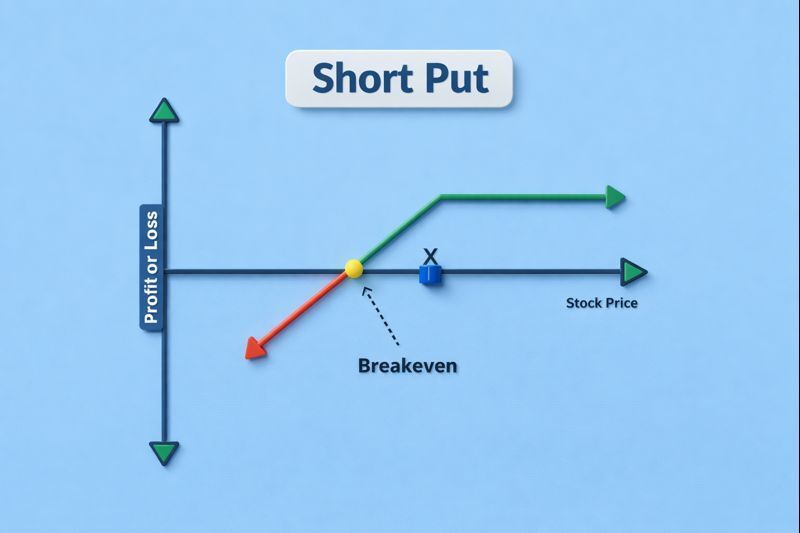
Outcomes at Expire
- NIFTY above 25,900: The option expires worthless. You keep the full ₹9,750.
- NIFTY at 25,750: This is your break-even. Profit/Loss is zero.
- NIFTY below 25,750: Losses begin. At 25,000, your loss would be: (25,750 - 25,000) X 65 = ₹46, 750
This put option example shows why short puts work best in sideways or mildly bullish markets.
Why the Strategy Works: Time Decay
One of the biggest reasons the short put option strategy works in the Indian Future & Options market is time decay, also known as Theta.
What Is Time Decay (Theta)?
Every option has a time value. As each day passes, this time value reduces, especially as the option approaches expiry. This reduction in value is called time decay.
- For option buyers, time decay is a disadvantage.
- For option sellers, it is a built-in edge.
How Theta Benefits Short Put Sellers?
When you sell a put option:
- You collect the premium upfront
- The option loses value every single day, even if the market does nothing
- As expiry gets closer, time decay accelerates
This means:
- The market does not need to move up for you to profit
- The price only needs to stay above the strike price
Even in a sideways or slightly falling market, a short put can still remain profitable because of Theta decay.
Why Beginners Miss This Advantage?
Most new traders focus only on direction: “Will the market go up or down?”
Professional option sellers focus on probability: “Will the market stay above this level for the next 7–14 days?”
This shift in thinking, from prediction to probability, is what gives the short put option strategy a higher chance of success.
Theta Accelerates Near Expiry
Time decay is not linear. It increases rapidly in the last few days before expiry. For example, an NIFTY put may lose ₹2–3 per day initially. In the final week, it may lose ₹10–15 per day. This rapid decay allows sellers to:
- Exit early with partial profits
- Reduce holding time and risk exposure
Note: While Theta is a seller’s primary advantage, it can be neutralised by Vega (Volatility risk). If you sell a put and the market gets very "scared" (Implied Volatility IV increases), the premium might actually go up even if time has passed. This is why sellers prefer selling when the VIX (Volatility Index) is high and expected to cool down.
Short Put Option Graph Explained
A short put graph helps visualise the payoff at expiry.
Short Put Option Graph Key Points
- Maximum Profit: Limited to the premium received
- Break-even Point: Strike Price − Premium
- Loss: Increases as price falls below break-even
Important Risk Clarification
Loss in a short put is not technically unlimited, since an index or stock cannot fall below zero. However, losses can still be substantial enough to cause serious capital damage if unmanaged.
Profits and Losses in a Short Put Strategy
Understanding the profit and loss structure is essential before using the short put option strategy. While the strategy offers a high probability of profit, it comes with clearly defined rewards and significant downside risk if the market moves sharply against you.
Maximum Profit: Limited but High-Probability
The maximum profit in a short put is limited to the premium received at the time of selling the option.
- Profit occurs when the underlying stays above the strike price at expiry
- The put option expires worthless
- You retain the entire premium as income
Condition for Maximum Profit
- NIFTY stays above 21,800 at expiry
- The put option expires worthless
Profit Calculation
Premium received: ₹120
Lot size: 65 units
120 × 65 = ₹7,800
Maximum Profit = ₹7,800
Break-Even Point
The break-even point is the price below which the strategy starts making a loss.
Break-even Formula: Strike Price − Premium Received
Example: 21,800 − 120 = 21,680
As long as NIFTY stays above 21,680 at expiry, the trade remains profitable.
The Loss Scenario: Downside Momentum
As you correctly noted, the loss is linear. For every 1-point fall below 21,680, you lose ₹65.
- Risk Type: While technically capped (Nifty cannot go below zero), it is practically substantial.
- Example: If Nifty crashes to 20,000:
Difference below Break-even: 21,680 - 20,000 = 1,680 points
Total Loss = 1,680 X 65 = ₹1,09,200
The Cash-Secured Put: A Smarter Way to Sell Puts
Instead of treating short puts as speculation, experienced traders use them to buy stocks at better prices.
Cash-Secured Put Example
- You want to buy HDFC Bank at ₹1,600
- You sell the 1,600 Put
- You keep enough cash ready for delivery
Results
- If the stock falls → you buy it at an effective discount
- If it doesn’t → you keep the premium as “rent”
This approach aligns derivatives trading with long-term investing.
Short Put vs Long Call: Which Is Better?
| Factor | Short Put | Long Call |
|---|---|---|
| Probability of Profit | Higher (60–70%) | Lower (30–35%) |
| Time Decay | Works for you | Works against you |
| Risk | Significant downside | Limited to premium |
| Capital Required | Higher (Margin) | Lower |
Short puts prioritise probability and consistency, while long calls chase large but infrequent gains.
Risks of Selling Puts
Below are the most important, up-to-date risks every put seller must know.
1. Leverage Risk:
The NSE’s 2026 revision of NIFTY lot sizes (75 → 65) has changed the leverage equation, but not eliminated the danger.
The Math
- NIFTY level: 26,140
- Lot size (2026): 65
- Contract value: 26,140 × 65 = ₹ 17 lakhs
- Margin required: ₹1.2 lakh
You are controlling ₹17 lakhs with ₹1.2 lakh, which is roughly 14× leverage.
Why This Is Dangerous
- A 1% fall in NIFTY = 261 points
- Loss per point = ₹65
- Approximate MTM loss = ₹17,000
That’s a 14% loss on your capital from just a 1% index move. This is why margin should never be confused with risk.
2. The Physical Settlement:
This is the single biggest hidden risk for retail traders selling stock puts. Since SEBI’s mandate:
- All stock options are physically settled
- If your short put expires ITM, you must buy the shares
What Changed in Practice
Brokers now enforce staggered delivery margins starting 4 trading days before expiry:
| Day Before Expiry | Delivery Margin Blocked |
|---|---|
| Friday (T–4) | 10% |
| Monday (T–3) | 25% |
| Tuesday (T–2) | 45% |
| Wednesday (T–1) | 70–100% |
The Forced Square-Off Risk:
If you do not have 100% contract value in cash (often ₹15–20 lakhs+) by Wednesday, your broker will:
- Forcibly square off your position
- Usually around 12:00 PM on Thursday
- Often during peak volatility
This leads to massive slippage, even if your original view was correct.
3. Margin Expansion:
During high-volatility events:
- Union Budget
- RBI policy
- Global macro shocks
- Sudden geopolitical news
The exchange raises SPAN margins.
What Happens in a Crash
1. Market falls → your short put shows MTM loss
2. Volatility spikes → broker demands extra margin
3. You face:
- Loss on position
- Plus an additional margin call (₹30,000–₹50,000+)
If you don’t have surplus funds, your position is closed near the bottom, locking in the worst possible loss.
4. Gap-Down Risk:
Stop losses do not protect against:
- Overnight global shocks
- Weekend news
- Sudden index rebalancing moves
A large gap-down can push losses far beyond planned limits before the market even opens.
5. Limited Reward vs Significant Downside:
In short, put option:
- Maximum profit = premium received
- Potential loss = many times the premium
This skewed payoff means: One badly managed trade can wipe out months of small gains.
6. Psychological Risk:
Selling puts tests discipline:
- Losses grow faster than profits
- Traders delay exits, hoping for a rebound
- Margin stress forces emotional decisions
Most blow-ups happen not because the strategy failed, but because the trader froze.
Physical Settlement: A Critical Rule in Indian Stock Options
Since 2019, SEBI mandates physical settlement for all stock F&O contracts.
Index vs Stock Options
- Index Options (NIFTY, BANK NIFTY): Cash-settled - no delivery risk
- Stock Options (Reliance, HDFC Bank, etc.): Physically settled - shares must be bought if ITM
Why Beginners Must Be Careful?
You may sell a stock put using a ₹2–3 lakh margin, but at expiry, you might need ₹15–20 lakhs or more to take delivery.
Important: Most brokers square off stock options 1–2 days before expiry if delivery funds are insufficient, often at unfavourable prices.
Conclusion
The short put option strategy is one of the most practical and probability-based approaches in the Indian futures and options market. It rewards patience, discipline, and risk awareness, not prediction.
By understanding what a short put is, respecting margin vs exposure, accounting for physical settlement, and leveraging time decay, traders can move from gambling to structured decision-making.
Trade small, manage risk, and let probability work in your favour, not hope.
Disclaimer: This article is for educational and informational purposes only and should not be considered investment, trading, or financial advice. Trading in Futures & Options involves significant risk and may not be suitable for all investors. Past performance is not indicative of future results. Readers are advised to understand the risks, comply with SEBI regulations, and consult a qualified financial advisor or tax professional before taking any trading or investment decisions.
Related Blog


The overall month has been quite unpredictable. While many on the chart stood strong, most of them have slipped. Bank Nifty on the other hand maintained its grip for a long time but now appears slightly bearish. Let’s see what the coming month holds for the investors as Mr. Sumeet Bagadia, Executive Director of Choice takes us through the weekly predictions of the market. Nifty Prediction For Next Week (24th August - 28th August 2026) The Nifty 50 witnessed a volatile week, with selling press
21 August 2026

Prism, the parent company of global travel-tech unicorn OYO, has moved closer to its proposed stock market debut after receiving clearance from the Securities and Exchange Board of India (SEBI), filing its Updated Draft Red Herring Prospectus (UDRHP), and beginning its roadshow for a proposed ₹6,650 crore initial public offering (IPO). The company, which is led by Ritesh Agarwal, has started meeting institutional investors as it prepares for its public-market debut later this year. The proposed
21 August 2026

FII DII Data Today 21th August 2026 CATEGORY DATE BUY VALUE (₹ Crores) SELL VALUE (₹ Crores) NET VALUE (₹ Crores) DII 21-Aug-2026 13,209.23 11,599.76 1,609.47 FII 21-Aug-2026 11,634.11 11,769.68 -135.57 What are FII and DII in the Stock Market Foreign Institutional Investors (FIIs) invest in the Indian stock market from international markets, while Domestic Institutional Investors (DIIs) include mutual funds and institutional bodies operating from India. fii dii data helps track
20 August 2026
Made for Traders.
Trusted by Investors.
Download FinX — trade confidently, invest
smarter, track everything.