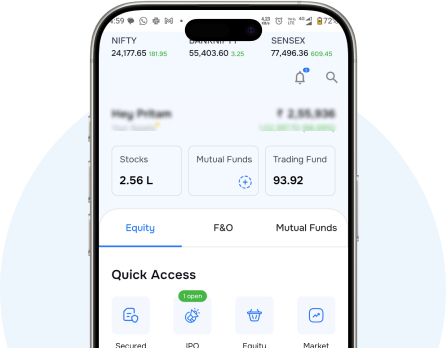

Today, online trading has almost replaced your physical stock market interface. Trading accounts are now a need for investing in stock markets successfully as it secures and expedites the entire share trading procedure.
What is a Trading Account?
A trading account refers to a day trader's main account. Traders' accounts are subject to particular regulation because of their propensity to frequently acquire and sell assets, usually during the same trading session. Assets stored in a trading account are kept apart from those that might be used in long-term purchase and holding plans.
Types of Trading Accounts
Cash Account
The total cost of all the stocks acquired must be paid in full by the client. In a cash account, all money and securities are the client's own, and they are unable to borrow money from their brokers to complete transactions.
Margin Account
The customer might obtain credit from their broker to support trading. This gives them an advantage as they can now purchase more securities than they could with sole funding. This involves some risk because if the stocks you purchased lose value, your broker will contact you and ask for the securities or cash to be deposited right away into the account. To make up for the loss, they may also sell your stocks.
Share Trading Account
It enables the purchase and sale of shares. Even though you can trade many different types of shares, this account cannot be used for any other transactions.
Option Account
An option is a contract that grants the buyer or seller the right to sell or purchase a security at a particular price and time. Only if the broker is confident in the investor's significant net worth may this account be opened.
Equity and Derivatives
This kind of account is opened with the stock exchange's trading members. A derivative is a contract whose value is determined by another agreed-upon asset or security.
Commodity Trading
Instead of dealing in produced goods, primary economic products are traded on the commodity market. As a result, a commodity trading account is a trading account that aids in the purchasing and selling of primary economic goods.
Benefits of a Trading Account
- The entire process is now one chain. Fund transfers, equity trading, and credits and debits to the bank, trading account, and Demat account all go relatively smoothly.
- National Stock Exchange (NSE), Bombay Stock Exchange (BSE), and Multi Commodity Exchange (MCX), you may access all these various markets with a single account thanks to the capabilities of an online trading account.
- If you can't get the correct information when you need it properly in the proper manner, value-added services are offered by online trading platforms. This includes futures and options strategies, trading calls, portfolio switch methods, research reports, and portfolio repair services.
- The fundamental point of an online trading account is to offer clients 24/7 specialized help. Technical problems or other management challenges with trading platforms could be the cause. To take things a step further, you can create unique notifications that you can send to yourself in certain situations.
Also Read: Trading Vs Investing
Steps for Opening Trading Account
Below are the the following process to open a trading account -
Choose the Stock Broker or Company
Make sure the broker is reputable and will accept your orders promptly. Keep in mind that timing is everything in the stock market. The market price of the stock might alter in only a few minutes. Therefore, be careful when choosing a broker.
Examine Brokerage Fees
For processing your orders, each broker levies a different fees on trading account. Some might charge more, while others might charge less.
- Some Discounts are Based on the Volume of Transactions
Remember that picking the broker with the lowest costs is not always a good idea. Providing high-quality brokerage services frequently may necessitate charging more than the usual fee.
Inquire About the Process for Opening a Trading Account
By contacting the brokerage company or broker, you can inquire about the process to open a trading account. The company would send a representative to your home with the KYC (Know Your Client) form and the account opening form. Complete these two forms and include two documents that serve as evidence of your identity and address with your submission.
Your application will be checked in person or over the phone, and you will be prompted to provide information. Upon completion, you will receive information about your trading account.
Trading Account Charges
- The Security and Exchange Board fee is the same for all equities and is assessed on both buying and selling sides of the transaction.
- The trading contract that you sign with the firm clearly outlines the various charges available.
- Security transaction tax (STT) is based on the value transacted or buying and selling of shares.
- A goods and services tax (GST) of 18% is applicable on the value of brokerage plus transaction fees.
Trading Account v/s Demat Account
Below are the following difference between demat and trading account -
Wide Definition
Trading Account - Could be viewed as a bridge connecting your bank and Demat accounts.
Demat Account - An account used to hold dematerialized assets like stocks, bonds, ETF and other securities in a electronic form.
Transaction
Trading Account - Primary function is to enable investors to execute trades.
Demat Account - The account cannot be used for transactions; it is solely intended to keep assets.
Yearly Fees
Trading Account - Generally free, varies by the company.
Demat Account - To be compensated by investors.
Time Duration
Trading Account - It is a cash flow statement that displays your trading activities over some time.
Demat Account - It is valued like a stock at a particular point in time, such as the conclusion of each financial year because it holds your shares.
Summing Up
Although it is now easy to register a Demat and Trading account, investors still need to approach the stock markets with a solid grasp of the markets and the instruments traded there. Stock investing involves market risk and needs to be done with professional advice. You can visit the Choice India webpage for further details.
Similar to a regular bank account, a trading account is used to buy and sell financial securities. It is crucial to choose the best broker with whom to register a trading account. Depending on the demands of the investor, various types of trading accounts are offered.
Related Blog

Zinc Price Forecast for Next Week (10th Aug - 14th Aug 2026) Support 2 Support 1 CMP Resistance 1 Resistance 2 373.75 380.60 389.20 397.60 410 LME Zinc futures gained around 2% over the week as concerns over tighter Chinese mine and smelter output supported prices. Production adjustments at a zinc mine in Southwest China are expected to reduce concentrate output by about 1,000 tonnes in August, while scheduled maintenance at a major Central Chinese smelter could cut refined productio
9 August 2026

FII DII Data Today 10th August 2026 CATEGORY DATE BUY VALUE (₹ Crores) SELL VALUE (₹ Crores) NET VALUE (₹ Crores) DII 10-Aug-2026 14,131.05 15,443.38 -1,312.33 FII 10-Aug-2026 12,467.13 10,396.26 2,070.87 What are FII and DII in the Stock Market Foreign Institutional Investors (FIIs) invest in the Indian stock market from international markets, while Domestic Institutional Investors (DIIs) include mutual funds and institutional bodies operating from India. fii dii data helps tra
9 August 2026

Nifty Prediction For Tomorrow The Nifty 50 tomorrow market prediction indicates a Sideways to Bullish trend. The range is between 24450 and 24750, with support at 24450-24500 and resistance at 24680-24750. Traders should monitor these crucial levels closely for potential market shifts. Nifty 50 Share Price * Nifty Support: 24450-24500 * Nifty Resistance: 24680-24750 * BIAS: Sideways to Bullish Nifty Range 24450 24750 Indian equity benchmark Nifty 50 ended the session almost un
9 August 2026
Made for Traders.
Trusted by Investors.
Download FinX — trade confidently, invest
smarter, track everything.