
What Are ESG Investments? A Detailed Guide
- Published Date: January 03, 2021
- Updated Date: December 15, 2025
- By Team Choice
Today’s investors want more than profit; they want purpose. ESG investing brings both together by helping you grow your wealth while backing responsible businesses. In this guide, you’ll discover what is ESG, how it works, the types of ESG investments available, the benefits and risks, and how to get started.
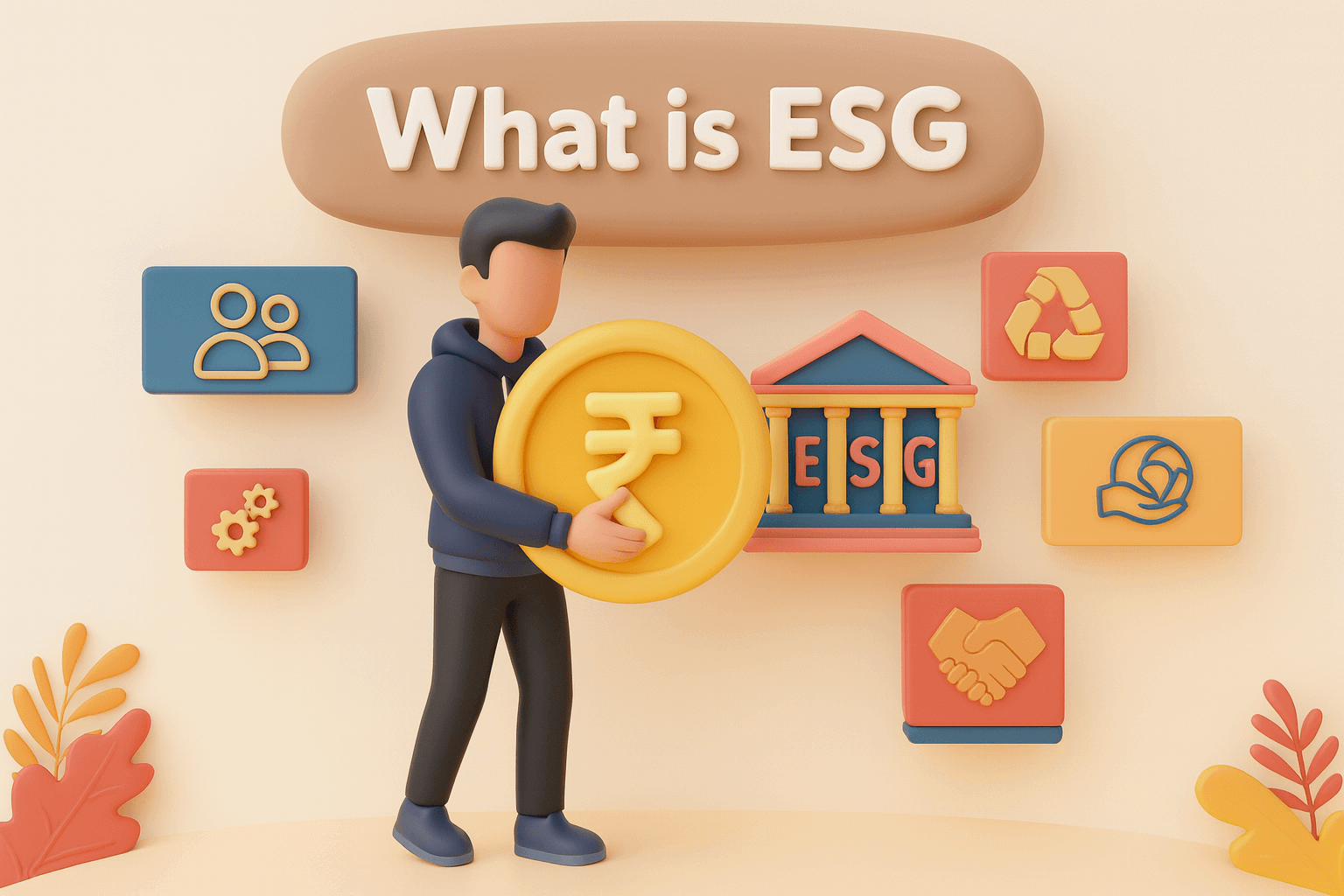
The Three Pillars: What is an ESG Investment?
If you are wondering “what does ESG stand for?”, here’s a simple breakdown:
- Environmental (E): Measures how a company impacts the planet.
Examples: Renewable energy usage, pollution control, waste management, carbon footprint, tracking Scope 1, 2, and 3 emissions.
- Social (S): Focuses on how a company treats people.
Examples: Employee safety, diversity and inclusion, community engagement, customer data privacy.
- Governance (G): The often-ignored but crucial pillar. Governance refers to how the company is run. While it may seem abstract to beginners, here’s what good governance looks like:
- Ethical and transparent leadership
- Fair executive compensation (not excessively higher than employee wages)
- Strong shareholder rights
- Independent board of directors
- Clear audits and financial reporting
- Avoidance of conflicts of interest
When you look at governance this way, it becomes easier to see why it matters. Poor governance often leads to scandals, fraud, and long-term financial risk.
Note: The three pillars are interconnected. A weakness in one area (e.g., poor Governance) often creates risk in another (e.g., environmental non-compliance).

How Does ESG Investing Really Work?
Before choosing ESG investments, it’s important to know how companies are evaluated and selected through the ESG process:
1. Screening (Choosing the Right Companies): Investors use screening to decide which companies fit ESG standards. This happens in two primary ways:
- Negative Screening: Excluding industries such as tobacco, weapons, gambling, and coal, or companies with poor labour practices.
- Positive Screening (Best-in-Class): Choosing companies with the highest ESG scores in each industry.
2. ESG Integration (The Most Common Approach): This is the most widely used technique, where investors systematically include ESG data alongside traditional financial metrics throughout the entire research and decision-making process. The analysis of ESG factors is seen as essential for risk management and identifying long-term opportunities.
3. ESG Scoring and Ratings: Agencies (such as MSCI and Sustainalytics) evaluate how companies perform across Environmental, Social, and Governance metrics. These scores help investors compare sustainability performance.
4. Analysis and Portfolio Building: Investors combine ESG scores with traditional financial analysis (e.g., revenue growth, profit margins, valuation ratios) to pick companies that are ethical and profitable. The goal is to find financially strong companies with high sustainability scores.
5. Active Ownership and Engagement (Driving Change): After investing, funds use their status as shareholders to drive corporate responsibility. This involves voting on shareholder resolutions and engaging in direct dialogue with company management to encourage stronger ESG policies and disclosures.
In short, ESG investing helps answer the question: What is ESG and why is it important? Because it supports long-term performance, reduces risk, and encourages responsible business behaviour.
Types of ESG Investments
Whether you're a beginner or a seasoned investor, ESG offers multiple ways to build a sustainable portfolio:
- ESG Mutual Funds & ETFs: Bundles of companies screened for strong ESG performance, great for beginners, as they offer instant diversification.
- Sustainable/Thematic Funds: Investment funds focused on a specific sustainability trend, such as clean water technology, circular economy, or battery storage/electrification.
- Green Bonds: Issued to fund renewable energy, clean transportation, and climate-friendly projects. They are generally considered lower risk than stocks.
- Individual ESG Stocks: Shares in specific companies leading in sustainability, clean tech, ethical supply chains, or strong governance.
- Impact Investments: Designed to create a measurable social or environmental impact (often involves direct investments in specific projects or enterprises and may be less liquid than stocks or ETFs).
- ESG in Private Markets: Investments made in private companies or debt that adhere to ESG principles, often targeting infrastructure or sustainable real estate.
SRI vs. ESG: A Quick Clarification
- SRI (Socially Responsible Investing) is older and values-driven, focusing mainly on exclusions (e.g., avoiding “sin stocks”).
- ESG is newer and data-driven, focusing on risk management, scores, and long-term opportunity.
Why Investors Choose ESG?: Key Benefits
Here’s why ESG investing has become one of the fastest-growing investment strategies worldwide:
1. Competitive Financial Performance and Resilience: Many beginners wonder: “Does ESG perform as well as traditional investing?” Yes, historical data shows that companies with strong ESG practices often demonstrate:
- Better risk management
- More stable cash flows
- Strong long-term competitiveness
- Performance that matches or even outperforms traditional benchmarks during volatile markets
- Improved Access to Capital (Lenders and banks often view high-ESG companies as lower credit risks, making it easier and cheaper for them to secure loans or issue bonds)
ESG isn’t just ethical; it can be financially smart.
2. Lower Long-Term Risk: Companies with weak governance or poor environmental practices face fines, scandals, lawsuits, and regulatory hurdles. ESG helps investors avoid such hidden risks that can suddenly damage stock value.
3. Aligns with Personal Values and Attracts Talent: You invest in businesses that support the planet, protect workers, and operate ethically. This ethical alignment also makes high-ESG companies more attractive to top talent (employees), which boosts productivity and innovation.
4. Supports Global Sustainability: Your investments can contribute directly to positive global change, such as funding renewable energy, social development, and ethical innovation.
Risk and Challenges of ESG Investing
It’s important to be aware that ESG investing isn’t risk-free. Here are some common challenges beginners often overlook:
- Inconsistent ESG Ratings: Different rating agencies use different criteria, weight metrics differently, and rely on varying levels of corporate disclosure, leading to significant score variations for the same company. This can make direct comparison difficult for investors.
- Greenwashing: Some firms and funds exaggerate their sustainability claims, often using marketing to make themselves greener than they really are.
Tip to avoid greenwashing: Always check a fund’s actual holdings, review its prospectus, and verify whether its investments truly match its sustainability promises.
- Potential Performance Trade-offs: ESG investing requires excluding entire sectors (like fossil fuels or tobacco) that may be temporarily highly profitable. This can lead to an opportunity cost or a performance drag when those excluded sectors outperform the market.
- Higher Costs: ESG-focused funds may have slightly higher management fees than traditional funds due to deeper research, third-party data requirements, and specialised analysis required for screening and integration processes.
- Limited Historical Data: Since standardised ESG frameworks and rigorous data collection are relatively new, long-term comparisons (e.g., spanning 30+ years) are still developing. This makes it harder to backtest certain strategies.
How to Start ESG Investing?
If you're ready to explore ESG investing, here’s a simple roadmap to help you get started with confidence:
- Define Your Goals: What matters most, environment, social impact, governance, or overall sustainability? Knowing your priority (e.g., climate change vs. worker rights) will narrow your choices.
- Allocate Your Capital: Decide what percentage of your total portfolio you want to dedicate to ESG investments. This could start small (5-10%) and grow as you gain confidence.
- Explore ESG Scores: Use reputable rating agencies or your investment platform’s ESG tools to research funds and companies.
- Choose Your Investment Type: Select vehicles that match your risk tolerance: ESG ETFs, mutual funds, green bonds, individual stocks, or SRI funds.
- Pick a Reliable Platform: Most major brokers and investment platforms now offer dedicated ESG filters and research tools.
- Review Annually: ESG standards and company performance evolve; monitor your portfolio's financial returns and ESG impact regularly, and realign as needed.
Future of ESG Investing
With increasing regulations, global climate awareness, and investor demand for transparency, ESG investing is expected to grow significantly. The future includes:
- More Standardised ESG Data: Regulations (such as the EU's SFDR and new rules in the US and Asia) will force companies to report sustainability metrics using consistent, standardised frameworks.
- The Rise of Technology: The use of Artificial Intelligence (AI) and satellite imagery will revolutionise ESG research, making data collection, verification, and analysis faster and more accurate, helping combat greenwashing.
- Regulatory Acceleration: Mandatory disclosure and reporting requirements from governments will rapidly shift ESG from a voluntary corporate choice to a regulated, essential business requirement.
- Growth in Clean and Renewable Energy Sectors: Significant capital will flow into areas necessary for the energy transition, including clean tech, renewable energy infrastructure, and resource efficiency.
- Investor Preference Shifting: Younger generations and institutional clients will continue to prioritise long-term sustainable wealth creation over short-term gains.
- Companies Improving ESG Disclosures: Driven by regulation and investor scrutiny, companies will become much more transparent about their environmental impacts and social policies.
ESG is transitioning from a trend to a mainstream investment strategy.
Conclusion
So, what is ESG investing? In simple terms, it’s a powerful investment strategy that allows you to grow your wealth while supporting companies that prioritise people, the planet, and ethical leadership.
By understanding the three pillars, Environmental, Social, and Governance, and the mechanics of screening and integration, you can make more informed choices that reduce portfolio risk and align with your personal values.
ESG is no longer a niche trend; it’s the mainstream future of finance. As regulations tighten and data quality improves, ESG investing offers a direct path toward long-term sustainable wealth creation.
Recommended for you
What Are Multi Cap Funds?

Copper Price Forecast for Next Week

Market Prediction Today (2th February 2026)